Translate

Sunday, October 21, 2007

What is an Anthroposophist?


One thing's for sure, it's not a person who says "I believe everything Rudolf Steiner said". That is the kind of Guru-worshiping complex he wanted to avoid. His desire would be that students think for themselves. 

To define an anthroposophist you'd have to define anthroposophy- it's not the kind of word a marketer would choose is it? 

There are many definitions of anthroposophy I've seen over the years- things like "Christian yoga after the coming of Michael", "the Wisdom in Man" or as it was termed during Steiner's theosophical days, "Rosicrucian Spiritual Science". But perhaps the best one is to be found in the Awakening to Community lectures.
In Dr. Steiner's own words:
The term "Anthroposophy" is really to be understood as synonymous with "Sophia", meaning the content of consciousness, the soul-attitude and experience that makes a man a fully fledged human being. The right interpretation of "Anthroposophy" is not "the wisdom of man" but rather "the consciousness of one's humanity". In other words, the reversing of the will, the experiencing of knowledge, and one's participation in the time's destiny, should all aim at giving the soul a certain direction of consciousness, a "Sophia".
Anthroposophy is a path of cognition from the spiritual in man to the Spiritual in the Cosmos:
Anthroposophy is a path of knowledge which would lead the spiritual in man to the spiritual in the Universe. It appears in men as a need of the heart and feeling. It must find its justification in that it can afford satisfaction to this need. Only he can acknowledge Anthroposophy who finds in it what he must seek out of his Gemut [a mind warmed by the heart].

Hence only those men can be called Anthroposophists who feel certain questions as to the nature of man and the world as life necessities in the same way as one feels hunger and thirst.
- Alfred Meebold's translation of Dr. Steiner's Leading Thoughts

Anthroposophy could only appear in the Consciousness or Spiritual Soul Age:


But such a coming together of human beings could take place only in our age, the age of the consciousness soul, and those who do not as yet rightly conceive the nature of the consciousness soul cannot understand this development..... It corresponds exactly to the developmental level of the consciousness soul period.

-Rudolf Steiner, Awakening to Community

"Anthroposophy is therefore the knowledge of the spiritual human being, or spirit-man, and that knowledge is not confined to man, but is a knowledge of everything which the spirit-man can perceive in the spiritual world, just as physical man observes physical things in the world. Because this second human being, the inner one, is the spiritual human being, the knowledge which he acquires may be called “Spiritual Science.” And this name is even less new than the name Anthroposophy. That is to say, it is not even unusual, and it would be a complete misunderstanding if anyone were to think that I, as has been said, or anyone closely connected with me, had coined the name “Spiritual Science.” The name is used everywhere where it is thought possible to attain knowledge which is not merely physical science, but knowledge of something spiritual. Numbers of our contemporaries call history a spiritual science, call sociology, political economy, aesthetics, and the philosophy of religion spiritual sciences. We use the name, only in a somewhat different sense, that is, in the sense that spirit is to us something real and actual, whereas most of those who nowadays speak of history, political economy, etc., as spiritual sciences, resolve the spirit into abstract ideas."

A Universal Single Occultism


"A theosophist has always before him the ideal of a universal single occultism, free of all religious prejudice."

Here Rudolf Steiner explains the ideals of theosophy, not as Eastern or Western but as a universal movement.

God is no respecter of personalities and neither is occultism.
"Occultism strips itself entirely of the personal element. Systems of philosophy arise directly out of the personal in man; occultism arises out of the impersonal and is on this account capable of general comprehension. And when it is a question of expressing occultism in terms of theosophy, the endeavor is always made to speak to every human heart and every human soul, and in large measure this can be done...."
Occultism- the same for all mankind:

"Occultism is in its results one and the same for all mankind. In reality there is no such thing as a difference of standpoint in occultism, — any more than there are different mathematics. It is only necessary in regard to any particular question to have the means actually at hand to acquire knowledge on on that question, and the knowledge will be the same as is reached by everyone who has the right means at his disposal.

"Thus, speaking in the ideal sense, we can just as little admit the existence of different standpoints in occultism as we can imagine there might be different standpoints in mathematics. Consequently occultism, wherever it has made its appearance, has always been recognised as single and universal. It is true that in the various theosophies that have existed from time to time and have supplied the outer cloak, so to speak, of occult truths, differences show themselves; but that is because the truths have had to be clothed differently for one folk or one epoch, than for another folk or another epoch. In other words, the differences between the theosophies that exist on the Earth lie in the manner of thought used to clothe the occult truths. The foundations of occultism are always and everywhere one and the same...."

"Occultism knows no such differentiations, it knows nothing that might stir up opposition between man and man. No cause for opposition exists, since occultism is the single undivided property of all mankind. And inasmuch as theosophy should in our time concern itself with the provision of a right and proper expression for occultism, it too must take care to absorb as little as possible of the differentiations that have manifested themselves in mankind. It must set itself the aim of being a faithful expression of occult truth and occult connections in so doing, it will inevitably also work for the overthrow of all specialised world-conceptions and help to break down religious differentiations."
There is no Eastern, Western, Christian, Buddhist Theosophy:
"We must learn completely to overcome the inclination to a theosophy of a definite stamp and coloring. It has gradually come about in the history of evolution that theosophies have tended to receive a certain nuance and coloring in accordance — I will not say with religious prejudices, but with religious preconceived feelings and opinions. Theosophy needs to keep constantly in view its ideal, — to be a reflection of occultism. There can therefore be no such thing as a Buddhist theosophy or a Hindu theosophy, or a Zoroastrian or a Christian. Naturally, regard must be had to the characteristic ideas and thoughts with which particular people will approach theosophy.

"Nevertheless it must never let go its ideal of being a pure expression for occult truth. It was, for example, a repudiation of the fundamental principle of occultists all the world over, when a theosophy made its appearance among certain societies in Central Europe, calling itself a "Christian" theosophy. As a matter of fact, you can just as little have a Christian theosophy as a Buddhist theosophy or a Zoroastrian."

"The relation theosophy has to assume to religion is that of an expounder of its truths. For theosophy is in a position to understand the truths of religion....."

"A great work for peace on earth would be accomplished if unity and harmony could be established in regard to the higher realms of occult knowledge. Let that stand before us as an ideal. It is hard of attainment. When one reflects how intimately men are bound up with their religious prejudices and with the whole way in which they have been educated, one will readily perceive the difficulty of presenting them with something that is not colored with any religious prejudice but is as faithful a picture as possible of occult knowledge.


"Within certain limits we must be prepared to recognise that as long as the Buddhist takes the standpoint of the Buddhist faith, he rejects the standpoint of the Christian. And if theosophy takes on a Buddhist coloring, then that Buddhist theosophy will quite naturally show itself inimical, or at any rate unsympathetic, to occultism. We shall also understand how difficult it is, in a realm where Christian forms prevail, to come to an objective knowledge, let us say, of those aspects of occultism which find expression in Buddhism. Our ideal, however, must always be to meet the one point of view with just as much understanding as the other and to establish over the whole earth a harmonious and peaceful relationship based on mutual comprehension.

"The Buddhist and the Christian who have become theosophists will understand one another, they will be sure to discover a standpoint where they are in harmonious agreement. A theosophist has always before him the ideal of a universal single occultism, free of all religious prejudice. The Christian who has become a theosophist will understand the Buddhist when he says: "It is not possible that a Bodhisattva who has passed from incarnation to incarnation and has at length become Buddha (as happened in the particular case with the death of Suddhodana) should afterwards return again into a human body.

"For in becoming Buddha he has attained to such a lofty stage of human evolution that he does not need ever to pass again into a human body." The Christian will reply to the Buddhist: "Christianity has not up to the present given me any revelation concerning Beings like Bodhisattvas, but as I strive after theosophy I learn to recognise not only that you know this truth out of your knowledge, but that I too must receive it as truth." For as theosophist, the Christian will say to himself: "I understand what a Bodhisattva is, I know that the Buddhist speaks absolute truth about these Beings, he utters a truth which could be spoken in lands where Buddhism prevailed. I understand it when the Buddhist says that a Buddha does not return again into a fleshly organism."

"The Christian who has become a theosophist understands the Buddhist who has become a theosophist. And if the Christian were now in his turn to address the Buddhist, he could say: "When one studies the Christian faith in its true occult content, as it is studied in occult schools, then one finds that the Being who is designated by the name of Christ" — the name of Christ may be quite unknown to the other — "is a Being who was never on earth before the time of the Mystery of Golgotha. He is a Being who can never come again in a physical body; for that would contradict the whole nature of the Christ."

"When the Buddhist who has become a theosophist hears this from the Christian, he will answer him in the following way: "Just as you understand how impossible it is for me to admit that a Buddha, after he has once become Buddha, can come again in a fleshly body, — just as you understand me, recognizing what has been imparted to me as truth, so am I ready to recognize the share of truth that has been communicated to you. I try to recognize what you receive from your faith, namely, that at the beginning of Christianity stands, not so much a Teacher, but a Deed, an Act." For the occultist places at the beginning of Christianity not Jesus of Nazareth, but the Christ, and he sets the actual moment of its beginning in the Mystery of Golgotha.

"Buddhism differs from Christianity in that it has a personal teacher as its starting-point, whereas Christianity has a deed, the deed of salvation and release, the deed accomplished by the death on the Cross on Golgotha. Not a doctrine but a deed stands at the foundation of Christian evolution. This the Buddhist theosophist understands, and he receives what is given as the occult foundation of Christianity and in doing so helps to establish harmony among mankind. He would be breaking the harmony if he were to apply to Christianity his Buddhist ideas.

"It is the part of the Christian, when he becomes theosophist, to understand Buddhism out of Buddhism itself, not to re-mould in some way of his own the ideas about Bodhisattva and Buddha, but rather to understand them as they are contained in Buddhism. Similarly it is the part of the Buddhist to receive the Christian ideas as they are, for they form the occult foundations of Christianity. Just as it is impossible to bring together the Being Who is named with the name of Christ with Beings of a lower kind, namely with Bodhisattvas, so also is it impossible, if we would remain loyal to the ideal of theosophy, to allow theosophy to be anything else than a faithful reflection of the single undivided occultism....."

"Occultism has always had the character of universality and is independent of every Buddhist as well as of every Christian shade of colouring. Hence it can understand objectively the Mussulman or the Zoroastrian or the Buddhist, even as it can also the Christian. What I have said will help you to see how it is that occultism, which is universal, has come to assume in theosophy so many different forms in the course of human evolution. And you will be able also to see why in our time it is so important to hold up as the ideal, not that one form of religion should gain the victory over the rest, but that all the different forms of expression of religion should mutually
understand one another. The first condition for this, however, is that men should come to an understanding of the occult foundations that are the same for all religions."


The Theosophists

Who are the theosophists?
The word means "Divine Wisdom" or the "Wisdom of God". It is not specifically Eastern, Western, Northern or Southern. Some of the famous theosophists of history are Paracelsus, Oetinger and Jacob Boehme; all of whom were Western or Christian theosophists - or you could be a Buddhist, Muslim or Jew; it doesn't matter.
The original impulse behind the modern Theosophical Society was a Rosicrucian one, according to Dr. Steiner- who was himself a member (honorary) of that said society (along with his wife Marie). The word "theosophical" was picked out of a dictionary at the time- other suggestions were: "The Miracle Club" and " The Egyptological Society". During the long period in which he was a member, he was also the leader of the German section from 1902 until 1912 (which included Austria and Switzerland).


 "Theosophy" is a book by Rudolf Steiner. Now the question is, if the Theosophical society taught Eastern doctrines why was Dr. Steiner allowed to teach his Western Rosicrucian teachings and be a leader of the section? He titled his teachings "Rosicrucian Spiritual Science" and began lectures with "My Dear Rosicrucian Friends". Why was this allowed to happen?
The reason is that the stated aim of the Theosophical Society was to avoid dogma. It was a truly open forum with members making up their own minds on whether they wanted follow Eastern or Western paths.

Theosophy is not a religion. In London during the time when H.P. Blavatsky was alive (1883), Dr. Anna Kingsford was the leader of the London Lodge and she taught her own brand of Hermetic Christian teachings.


G.R.S Mead became Blavatsky's private secretary and also joint-secretary of the Esoteric Section of the Theosophical Society. He made many contributions to the Theosophical Society's Lucifer as joint editor, and eventually became the sole editor of The Theosophical Review in 1907 (as Lucifer was renamed in 1897).

He was attracted to western esotericism, religion and philosophy, but had to leave the TS in 1909 over the Leadbeater affair. "As of February 1909, Mead and some seven-hundred members of the Theosophical Society's British Section resigned in protest at Annie Besant's reinstating of Charles Leadbeater to membership in the society."

HPB moved away from the Rosicrucian to a more Eastern approach- first Indian Hindu and then Tibetan Buddhist. But her teachings were never meant to be dogma.

These are the aims of one of the Theosophical Societies:
  • To form a nucleus of the Universal Brotherhood of Humanity, without distinction of race, creed, sex, caste, or color.
  • To encourage the study of Comparative Religion, Philosophy, and Science.
  • To investigate unexplained laws of Nature and the powers latent in Man.
There is nothing there about it being a path, setting up a new religion or having dogmas (Eastern or otherwise) and forcing people to believe one thing or another. You often find folk with a wide variety of views speaking at theosophical societies around the world. 

As I said, theosophy is not a path.  If someone wants to talk about anthroposophy or any other form of occultism, at the Theosophical Society they can- this goes for the Adyar society.

If Annie Besant had accepted Steiner instead of Leadbeater as her guide, there may never have been an anthroposophical society. Dr. Steiner was in no hurry to leave - as mentioned above, some seven hundred had already left the British Section over the Leadbeater affair in 1909.


But things became unbearable with the Krishnamurti issue - also the establishment of a religion was against the statutes. In 1929 Krishnamurti himself repudiated the great claims made for himself.

As Rudolf Steiner said, the TS was not an occult movement but a place where occultism was discussed. It was, as he saw it, a place for discussion, where each and every member was as important as another.

"Theosophy per se, nor yet its humble unworthy vehicle, the Theosophical Society, has anything whatever to do with any personality or personalities! For real Theosophy IS ALTRUISM, and we cannot repeat it too often. It is brotherly love, mutual help, unswerving devotion to Truth. If once men do but realize that in these alone can true happiness be found, and never in wealth, possessions, or any selfish gratification, then the dark clouds will roll away, and a new humanity will be born upon earth. As all work for one and the same object, namely, the disenthralment of human thought, the elimination of superstitions, and the discovery of truth, all are equally welcome."
— H.P. Blavatsky


Tuesday, October 16, 2007

Personal Ego Eclipsed

In the twelfth lecture of St. John Dr. Steiner says that when a person is illuminated with the Holy Spirit according to esoteric Christianity, "he speaks forthwith in a different manner."
"How does he speak? When he speaks about Saturn, Sun and Moon, about the different members of the human being, about the processes of cosmic evolution, HE IS NOT EXPRESSING HIS OWN OPINION. His views do not at all come into consideration. When such a person speaks about Saturn, it is Saturn which is speaking through him. When he speaks of the Sun, the Spiritual Being of the Sun speaks through him."

[All these beings speak through him.]
"HE IS THE INSTRUMENT. His personal ego has become eclipsed, which means that at such moments it has become impersonal and it is the Cosmic Universal Ego that is using his ego as its instrument through which to speak."
-Gospel of John lectures- Rudolf Steiner

So isn't Dr. Steiner speaking of himself here?
His personal ego had "become eclipsed". This is not to be confused with a surrendering of the ego as in trance mediumism.


Cosmopolitanism

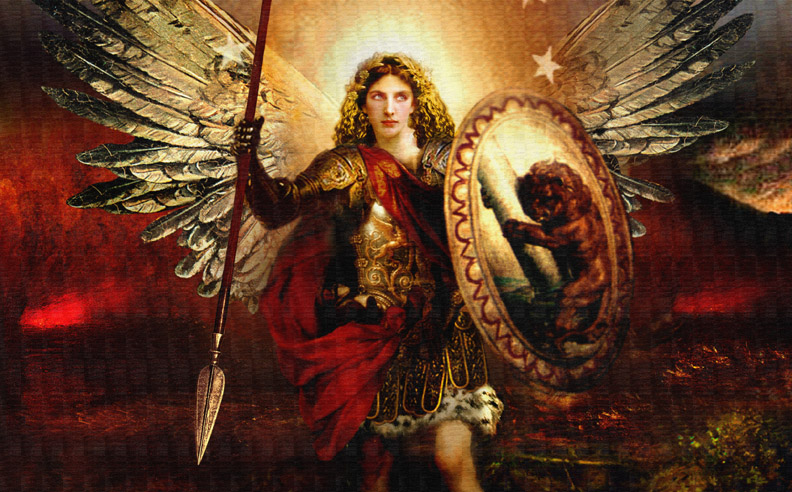
Spiritual beings who are the direct followers of the Archangels wanted to spread uniformity over the whole of mankind. If this were given free rein mankind would have been one "indistinguishable species". Other beings had the task of spreading differentiation among mankind so that this wouldn't occur. With the coming of Michael in the nineteenth century, this period of differentiation came to an end.
"These spiritual beings who had to be fought by the Archangel Michael being a time spirit, have always affected the life and evolution of mankind; during the past millenia, prior to the middle of the nineteenth century, their task in the spiritual world was to create differentiation among human beings. ...."

"These spiritual beings, however, against whom the Michaelic principle had to fight, had the task of spreading differentiation among mankind, to split humanity into races and peoples; to bring about all those differences that are connected with the blood and with the nerve temperament. This had to happen. They may be called Ahrimanic beings, and we must realize that the Ahrimanic principle was a necessity in the course of mankind's evolution.

"Now a time of great significance arrived in the evolution of mankind beginning with the forties of the nineteenth century. The time arrived WHEN THE DIVIDED HUMAN RACE HAD TO BE FORMED INTO A UNITY.

"You see, the cosmopolitan views which, to be sure, sometimes turned into cosmopolitan slogans in the eighteenth and first half of the nineteenth century, are simply a reflection of what occurred in the spiritual world. The tendency exists in mankind to wipe out the various differences which were fostered by the blood and nerve temperament. It is not a tendency of the spiritual worlds to create further differences among mankind, but it is a tendency of the spiritual worlds to pour a cosmopolitan element over mankind."
Signs of the times, Michael's Battle and its Reflection on Earth, Lecture 2, Rudolf Steiner.


Rudolf Steiner GA 180, 1918 Jan 5:
"...chauvinism is the remnant of an impulse that once was lived in a very different way......what does the national feeling full of passion show, from which powers does it spring? - From sexuality, only in a different form".
 

'But always when an age of Michael dawns, a longing begins to arise in mankind to overcome racial distinctions and to spread through all the peoples living on the Earth the highest and most spiritual form of culture produced by that particular age. Michael's rulership is always characterised by the growth of cosmopolitanism, by the spread of a spiritual impulse among peoples who are ready to receive it, no matter what language they speak. Of the seven Archangels who send their impulses into the evolution of humanity, Michael is always the one who gives the cosmopolitan impulse — and at the same time the impulse for the spreading of whatever is of most intrinsic value in a particular epoch.'

- Rudolf Steiner, Karmic Relationships, VI: Lecture VIII
Arnhem, 19th July, 1924