Translate

Monday, July 12, 2010

Even This Shall Pass Away

Once in Persia reigned a King
Who upon his signet ring
Graved a maxim true and wise,
Which, if held before the eyes,
Gave him counsel at a glance,
Fit for every change and chance.
Solemn words, and these are they:
"Even this shall pass away."

Trains of camels through the sand
Brought him gems from Samarkand;
Fleets of galleys through the seas
Brought him pearls to match with these.
But he counted not his gain
Treasures of the mine or main;
"What is wealth?" the king would say;
"Even this shall pass away."

’Mid the revels of his court
At the zenith of the sport,
When the palms of all his guests
Burned with clapping at his jests;
He amid his figs and wine,
Cried: "Oh loving friends of mine!"
"Pleasure comes but not to stay;"
"Even this shall pass away."

Lady fairest ever seen,
Was the woman he crowned his queen,
Pillowed on his marriage bed,
Softly to his soul he said:
”Though no bridegroom ever pressed,
Fairer bosom to his breast,
Mortal flesh must come to clay,
Even this shall pass away!”

Fighting on a furious field,
Once a javelin pierced his shield;
Soldiers with a loud lament
Bore him bleeding to his tent;
Groaning from his tortured side,
"Pain is hard to bear," he cried,
"But with patience, day by day,
Even this shall pass away."

Towering in the public square,
Twenty cubits in the air,
Rose his statue, carved in stone,
Then, the king, disguised, unknown,
Stood before his sculptured name
Musing meekly, "What is fame?
Fame is but a slow decay
Even this shall pass away."

Struck with palsy, sere and old,
Waiting at the Gates of Gold,
Said he with his dying breath;
"Life is done, but what is Death?"
Then, in answer to the King,
Fell a sunbeam on his ring,
Showing by a heavenly ray,
"Even this shall pass away."

- Theodore Tilton
1835-1907


Tuesday, May 18, 2010

Water & the Sacraments

By Leszek Forczek

"
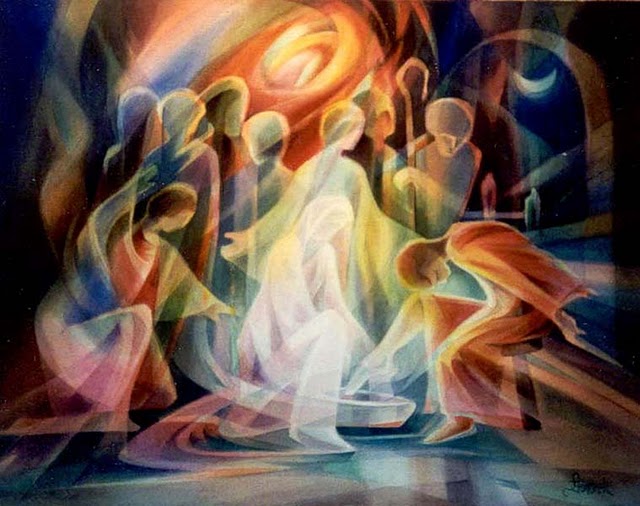
Foot washing or washing of feet is a religious rite observed as an ordinance by several Christian denominations. The name, and even the spelling, of this practice is not consistently established, being variously known as washing the saints' feet, pedilavium, and mandatum.


The rite of foot washing finds its roots in scripture. After the death of the apostles, the practice was gradually lost. Nevertheless, it appears to have been practiced in the early centuries of post-apostolic Christianity, though the evidence is scant. For example, Tertullian (145-220) mentions the practice in his De Corona, but gives no details as to who practiced it or how it was practiced. It was practiced by the church at Milan (ca. A.D. 380), is mentioned by the Council of Elvira (A.D. 300), and is even referenced by Augustine (ca. A.D. 400). Observance of foot washing at the time of baptism was maintained in Africa, Gaul, Germany, Milan, northern Italy, and Ireland.


According to the Mennonite Encyclopedia "St. Benedict's Rule (A.D. 529) for the Benedictine Order prescribed hospitality feet washing in addition to a communal feet washing for humility"; a statement confirmed by the Catholic Encyclopedia. It apparently was established in the Roman church, though not in connection with baptism, by the 8th century. The Albigenses observed feet washing in connection with Communion, and the Waldenses' custom was to wash the feet of visiting ministers. There is some evidence that it was observed by the early Hussites. The practice was a meaningful part of the 16th century radical reformation. Foot washing was often "rediscovered" or "restored" in revivals of religion in which the participants tried to recreate the faith and practice of the apostolic era.”

"In the third century there are traces of a custom of washing the hands as a preparation for prayer on the part of all Christians; and from the fourth century onwards it appears to have been usual for the ministers at the Communion Service ceremonially to wash their hands before the more solemn part of the service as a symbol of inward purity."
-Report of the Royal Commission on Ecclesiastical Discipline (Church of England) 1906

The Lavabo

“A lavabo is a device used to provide water. In ecclesiastical usage it is the basin in which the priest washes his hands after preparing the Altar before saying Mass. The room in which it is kept is the lavatory. The word can also refer to a specific ritual in the Mass.

"The name Lavabo ("I shall wash") is derived from the words of the 26th Psalm, which the celebrant is directed in the Missal to recite during the ceremony; "I will wash my hands in innocency, O Lord, and so will I go to Thine altar." As he says this, he ritually rinses his hands in water, usually assisted by an altar server. This part of the Mass is referred to as the Lavabo.”

Monastic practice

In many early and medieveal monasteries, there would be a large lavabo (lavatorio) where the brethren would wash their hands before entering church. This practice was first legislated in the Rule of St. Benedict in the 6th century, but has earlier antecedents. St. John Chrysostom mentions the custom in his day of all Christians washing their hands before entering the church for worship.


In the Communion
Water was the sacramental substance of choice in the ancient mysteries, as it continued to be with Mithraism and the Manichaeans. The early Christian Ebionite sect also used water. The groups that performed the water Communion were referred to as the Aquarii. Even a Catholic saint, St. Pionius was present at a water Communion.


"The Encratites, who opposed the use of all intoxicating drinks, consistently communed with water. In the fourth century the users of water in the Communion were called "Aquarii" or "Hydroparastatae" and, under the Code of Theodosius, were liable to death for their practice."

"Others known as having substituted water for wine are: Tatian, a pupil of Justin Martyr; Galatia, the confessor of Alcibiades of Lyons; Pionius, the Catholic martyr of Smyrna; the Marcionites; the Montanists; the Elkasaites; and the Therapeutae of Philo."
End of quote
By his coming again Christ means his reappearance in the Sixth sub-race when he will be proclaimed by the ‘Water-Man’.

-Rudolf Steiner


Masaru Emoto, a creative and visionary Japanese researcher, has published an important book, Miraculous Messages from Water.


"From Mr. Emoto's work we are provided with factual evidence, that human vibrational energy, thoughts, words, ideas and music, affect the molecular structure of water…"

Rudolf Steiner, Background to the Gospel of St. Mark, Lecture 7:

It is also a fact that there are individuals who enjoy washing their hands as often as possible, and others who do not. Understanding of such an apparently trivial fact actually demands very advanced knowledge. To a clairvoyant the hands of a man are remarkably different in a particular respect from all his other bodily members. Luminous projections of the etheric body stream out from the fingers, sometimes glimmering faintly, sometimes flashing far into the surrounding space. The radiations from the fingers vary according to whether the man is happy or troubled and there is also a difference between the back of the hands and the palm. For anyone able to observe clairvoyantly, a hand, with its etheric and astral parts, is a most wonderful structure. But everything in our environment, material though it be, is a revelation, a manifestation, of the spirit. You should think of matter as being related to spirit as ice is to water; matter is formed out of spirit — call it ‘condensed spirit’ if you like. Contact with any material substance means contact with the spirit in that substance. All our contact with anything of a material nature is in fact — to the extent that it is purely material — maya. In reality it is spirit with which we come into contact.

If we observe life with sensitivity, we shall realise that washing the hands — especially if it is done frequently — brings a man into contact with the spirit in the water and has a considerable effect upon his whole disposition. Some individuals have a great fondness for washing their hands; directly the least speck of dirt gets on their hands they must be washed! Such characters either have, or will develop, a very definite relation to their surroundings, a relation not entirely the outcome of material influences. It is as if delicate forces in matter were working upon such individuals when there is this relationship between their hands and the element of water. Even in everyday life you will find that these people have an entirely healthy kind of sensitivity and more delicate powers of observation than others. They are at once aware, for instance, whether someone standing near them has a brutal or a kindly disposition. On the other hand, individuals who do not mind their hands being dirty are actually of a coarser disposition and erect a sort of barrier between themselves and their environment. This is a fact and can actually be observed as being characteristic of certain groups. Travel through certain countries and observe their inhabitants. In regions where people tend to wash the hands more frequently, you will find that relations between friend and friend are very different from what they are in regions where people wash their hands less often and erect a sort of barrier between one another.

These things have the validity of natural law, though the details may be affected by various circumstances. If we throw a stone into the air the line of projection is a parabola; but if the stone is caught by a gust of wind there will no longer be a pure parabola. This shows that all the relevant facts must be known if certain relationships are to be accurately observed. As to the hands, clairvoyant consciousness reveals that they are permeated by soul and spirit — to such an extent, indeed, that a definite relationship of the hands to the water is established. This holds good less in the case of the human face and less still in the case of the other parts of the body. This must not, however, be interpreted as an objection to washing or bathing but rather that we must keep our attention fixed on the relevant circumstances.

The point here is to show how very differently the soul and spirit are related to and express themselves in the various parts of the body. You are not likely to find that anyone does harm to his astral body by washing his hands too often, but the point must be considered in its widest range. The relationship between hands and water may exercise a healthy influence on the relation between man and his surroundings, that is to say, between his astral body and his environment; and for this reason things will not readily be carried to extremes. But those who think materialistically and allow their thoughts to be attached solely to matter will say that what is good for the hands must be good for the rest of the body. This would show that differences depending on delicate perceptions entirely escape notice; the consequence -- and it is abundantly in evidence — is that for certain purposes the same treatment is applied to the whole of the body. For instance, frequent cold baths and constant cold water frictions are recommended as a particularly effective treatment, even for children. Fortunately, because of obvious effects on the nervous system, doctors have already begun to realise that these treatments have been carried to absurd extremes. What is right for the hands because of their particular relation to the astral body can become an injurious experiment when applied to parts of the body having a different relation to the astral body. Washing the hands may bring about a healthy sensitivity to the environment; but an excessive use of cold baths and the like may cause an unhealthy hypersensitivity which, especially if such treatment is applied in childhood, lasts for the whole of life.

It is therefore all-important to know the limits within which methods may be beneficially applied; and this will be possible only if there is willingness to acknowledge that higher members of man's being are incorporated in his physical body.


The Great Shaking- Muditch Boongurang

Here is an interesting Aboriginal story from Western Australia, which appears to demonstrate an ancient pole-shift:

Long long ago before the tribes were formed, the shape of the land was completely changed by a terrific upheaval known as the Great Shaking. There were fearful rushes of wind accompanied by smoke and dust. For days and weeks and months it continued until suddenly it ceased and everything grew strangely quiet and still. For a day or more there was not a breath of wind, and there seemed to be no air to breathe. Those who had survived went about gasping for breath, and many died. At length came a welcome wind which revived the few who remained alive. But this was followed by another shaking and terrible claps of thunder, and great waves came rushing all over the land.

When the Big Water came, the surviving people and the animals were on a high hill, which saved them from being drowned. After a little while this strange Big Water rushed back back to the places from which it had come, and in its wake left huge quantities of fish, such as men had never seen before. The people could see all these fish leaping about on the plain below. They descended, gathered up the fish, and cooked and ate them, for they were in need of food, which had been difficult to get since the Great Shaking.

The people were puzzled at the strange changes that had taken place on account of the Great Shaking and the Big Water. Where there had been hills there were now plains, and where there had been plains there were now hills. But the most extraordinary thing was that the Sun did not rise or set in the same direction as before. Instead of rising on the north and setting in the south, it now rose in the east and set in the west.


-Taken from An Attempt to Eat the Moon, & other stories, recounted from the Aborigines in the Margaret River region of Western Australia, by Deborah Buller-Murphy, 1958.


Sunday, April 25, 2010

The Deeper Side to Water


Water has Memory
From The Institute for Static and Dynamics for aerospace constructions of the University of Stuttgart. Here is a website of the project: http://www.weltimtropfen.de

Saturday, March 27, 2010

First Causes & Principles

"In the beginning, my dear, the world was just Being (sat), one only, without a second. To be sure, some people say: 'In the beginning this world was just Non-being (a-sat), one only, without a second; from that Non-being was produced."

-Chandogya Upanishad, i. 9.1.

The speaker then goes on to contest the idea that Being could arise from Non-being. Thus the debate continues.

These kind of thoughts are not discussed within the Christian Church but it is something Christian initiates have looked at.

In the opening verse of Genesis the Hebrew word BERAESHITH is translated as "in the beginning". If you were to ask a Rabbi he would tell you that the word means "in the principle" or "at-first-in-principle" or "archetypal." Water is already in existence.

Here are the first verses of Genesis translated by Fabre d'Olivet:

"1. At-first-in-principle, he-created, Elohim,
the-selfsameness-of-heavens, and-the-selfsameness-of-earth.

2. And-the-earth was contingent-potentiality in-a-potentiality-of-being; and-darkness-was-on-the-face of-the-deep and-the-breath of-HIM-the-Gods was-pregnantly-moving upon-the-face-of-the-waters.

3. And-he-said HE-the-Being-of-beings: there-shall-be light; and-there-became-light.

4. And-he-did-ken, HE-the-Gods that-light as good; and-he-made-a-division HE-the-Gods, betwixt the-light-and-betwixt the-darkness."

In the first chapter the name of God is Elohim, from the fourth verse onwards, it is Yahweh-IHOAH-Jehovah Elohim.

A book that is a very good primer is Eduard Schuré's From Sphinx to Christ. In it he makes the comment:

"Esoteric tradition holds that, at the same period [the Moon condition of Earth], a certain number of Elohim, who did not wish to take part in the creation of the Earth and of other worlds subject to the laws of condensed matter, left the Sun in order to create Uranus, Neptune and other planets beyond the Saturnine region.....Therefore is Saturn the oldest of the gods, and the one with whom Time began."
Comments by Rudolf Steiner:

"There are still deeper forces which can be active in men, the forces of the outermost planet of our solar system. Modern astronomy does not regard it as the outermost since it has added two more- though even orthodox astronomers are worried because the movement of the moons does not properly fit,* but since it is the spatial arrangement with which they are concerned, they have added Uranus and Neptune. These, however, cause trouble because their moons are a little crazy compared with the ordered moons of Jupiter and other planets. In reality one must say that, for a living, concrete grasp of the planetary system, Saturn is the outermost planet.

* The moons of Neptune and Uranus move in the opposite direction to the satellites of other planets."
This was the argument of the gods which still goes on to this day:

."...It was partly due to this end that the Luciferian supporters maintained that the Earth was born out from a laggard evil; and enough too to calm the purists in their discontent against the notion of evolution and development - given the double distinction against perfection that the two seem to imply. "
But our business on Earth has a great purpose:
"as men we can bring in the holy powers through to our earth element nature as manifested. As men, through Christ, we nurture both the spiritual and the physical realms, when we transmute the Earth sphere with His goodness.
 
"Lucifer contended that Paradise be kept for all time. He had refused the new futures to come, believing that the beauty of the past offered all of Man's requirements for his subsequent being. However, nothing may keep outwardly without decaying in such preserve. The souls themselves of Man would stultify if withheld in a perpetual paradise that held no inner reality or hard-won substance to it."

- B.Hive