Translate

Sunday, November 03, 2013

Love Is Endless- Thomas Lake Harris

As I mused, in fancy friendless,
While the shades of evening fell,

From the land where Angels dwell

Came the whisper, "Love is endless,
Endless, endless!"
From the land where Angels dwell.

From my thought the Vail was taken;
In my heart I knew that Love,
From its holy home above,
Gently came my soul to waken,
Waken, waken,
From its blessed home above.


Then from all its load of sorrow,
Lifted up, my mind was free;
Full of gladness, dawned on me,
Love-inspired, a better morrow,
'Morrow, morrow,
Full of gladness, dawned on me.


Heavenly dew of peace descended,
And my Lord, from His Divine,
Comforted this heart of mine;
All my grief in love was ended,
Ended, ended—
Comforted this heart of mine.

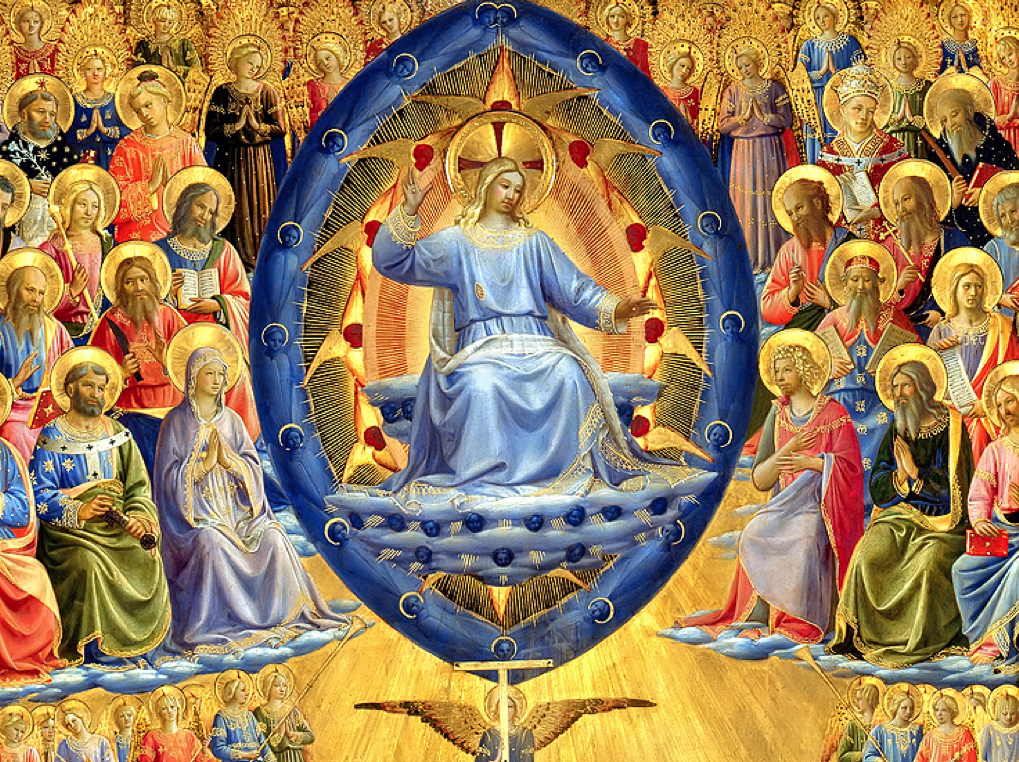
Jesus speaks the heart's evangel,
"Love is endless!" His behest
Fills with life the happy breast.
Nearer He than man or Angel,
Angel, Angel;
Love is endless in my breast.

Nearer draws the blest Elysian;
Perfect glows the holy spell;
Love is endless; all is well.

Brighter grows the heavenly vision,
Vision, vision;
Love is endless; all is well.
I ceased; and as the dying strain,
Like a white cloud, afar was lifted,
My bosom grew inspired again,
My heart with melody was gifted.
I poured my rapid thought in words,
Till music shook the chords of Heaven;
Those golden chords, those golden chords,
Those heavenly harp-strings, three and seven
The threefold chords and strings of air,
The sevenfold breath of perfumed sweetness,
In music thrilled, as, free from care,
I sang the Hymn of Life's Completeness.

-T.L.Harris


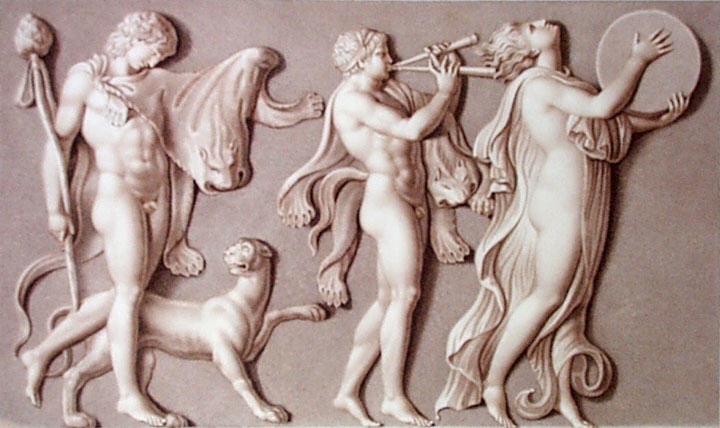
Dionysos & the Wedding at Cana


Archbishop Temple in his book, Readings in the Gospel of St. John says, "The modest water saw its God, and blushed."
This is quoted by Alfred Heindenreich in his The Unknown in the Gospels.

More from there:
".....The Fourth Gospel by Sir Edwyn Hoskyns. This great scholar draws our attention to the fact that the change of water into wine also has its background not only in the Hermetic literature, but even in Greek philosophy and poetry. He quotes from one of Plato's dialogues where he says that poets are inspired and possessed 'like Bacchic maidens, who draw milk and honey from the rivers, when they are under the influence of Dionysos, but not when they are in their right mind.' Plato suggests that the maidens connected with the cult of Bacchus or Dionysos, in a certain state of mind, draw milk and honey from the rivers."

"This happens when the devotees of Bacchus, of Dionysos, go out under the spell, under the influence - you might say, under the blessing - of the god.
It is somewhat on those lines, on that level, that we now approach the understanding of this significant deed recorded in St. John's Gospel."

"Had we been called to a wedding in ancient times, what would we have seen? Let us assume that the customary beverage, wine, had all been used. What would have happened? Given the right conditions of blood-relationship among the members of this wedding party, we might have experienced, for instance, that the water which, at a later moment of the feast, had been offered in place of the wine had been experienced as wine by the guests, through the magical force of consanguineous love."

"Wine, not water, would have been drunk had the proper magical conditions prevailed among these people. Do not say that the wine would have been water none the less, for it is reasonable to say that, in such circumstances, things are what they do to us, what effect they have on our organism, not what they appear to be . . The power to experience in this manner prevailed among those who were present at the marriage at Cana in Galilee.

-The Gospel of St John, Rudolf Steiner

"In a subsequent lecture (XIV in the same course RS ) he comes back to this once more, and says that through his special training the author of the Fourth Gospel "understood that it was possible to transform that which appears outwardly as water so that it becomes changed into wine by being taken into the human organism when it is drunk".


"There is another detail in the story which has puzzled theologians. You remember there are the six pots of water according to the Jewish custom of ceremonial ablution. They are described as holding between them something like one hundred and fifty gallons- a colossal amount. Although they were filled, however, the Gospel in the Greek suggests that the servants now go out once more and draw. It was Bishop Westcott who drew attention for the first time to that peculiar phrase, a phrase used now, "draw again from the source". Steiner says this is vital, and it shows just how accurate John is."

"What kind of water was required by Christ? He needed water drawn from the sources of nature. Hence it must be expressly stated that the water had been freshly drawn. Water that had not yet lost the inner life force which any element possesses so long as it remains united with nature such water alone could be suitable for His purpose."

"Steiner sums up his discussion on this first sign by saying that special importance is attached to the fact that the Christ-power worked upon the other soul prepared to receive it so that a result was evoked.

"The essential point is that the Christ force has the power to prepare the other soul so that these effects can show themselves. Christ rendered the wedding guests susceptible so that they also tasted the water as wine.

"Putting it in terms of the ancient mysteries, He acted like Dionysus. This is by no means a far-fetched idea; if you go to Rome and visit the catacombs, some of the tombs excavated under St. Peter's, you find Christ actually depicted by the early Christians as Dionysus. Perhaps we can see why."

The other point is, that up to the Mystery of Golgotha alcohol had not completed its mission. This was the "turning point of time" and alcohol then worked in a different way. The Christ now brought us the full power of the Self.


Friday, November 01, 2013

Male-Female Made He Them


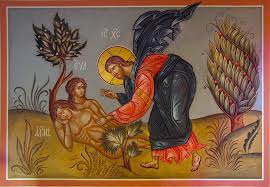
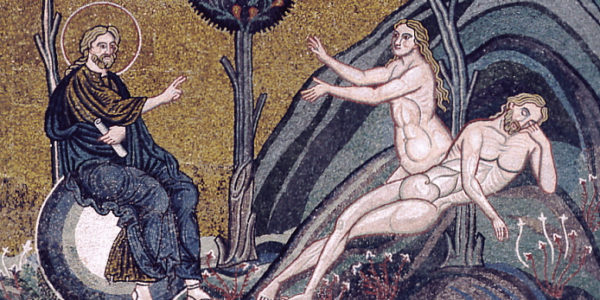
In reading Genesis 1:26-28, and Genesis 5:2 we find that at first the name "Adam" belonged equally to male and female. God said: "Let US make man [or "Adam,"--it is the same word] in our likeness" and the story proceeds "In the image of God made HE HIM, male and female made HE THEM." Note that in the second clause, man is spoken of as both singular and plural. Adam was of both sexes- a hermaphrodite.

There is no "and" in the Hebrew. It is "in the image of God made HE HIM,"male-female" made He them." And you see that this was before Eve was formed, so it wasn't talking about her. This was known by Blavatsky and Steiner too.


This theory has been held among the Jews, at least as far back as the days of Jesus Christ, as shown by the writings of Philo, that man was, at the beginning male and female in one person. This belief will also be found among other peoples besides the Jews. After the androgynous state, it is thought that human beings were born in pairs, male and female twins.

This is called the separation of the sexes. In the past children born as hermaphrodites were considered to be quite special, godlike - not like in recent years where they have been operated on because they don't 'fit in' with a notion of normality.

Eve was not made from Adam's rib either. The Hebrew word is "tsela" which means "side". Nowhere else in the Bible is the word "tsela" translated as "rib". 

This lends force to the Lord's words in Matthew 19:4, concerning the sanctity of marriage. We must remember He was speaking to men who were doubtless familiar with the theory: "Have, ye not read, that He Who made [no "them" in the original] from the beginning made them male and female." Again the rabbis did not seem to recognize an "and" in the expression in Genesis, "male and female," but read "male-female."

This saying of our Lord now makes perfect sense. We now know what He meant by "one flesh"- reflective of the first perfect Man- Adam Kadmon.

Dr. Hershon, in his book, Talmudic Miscellany, says: "There is a notion among the rabbis that Adam was possessed originally of a bi-sexual organism, and this conclusion they draw from Gen. 1:27, where it is said, 'God created man in His own image; male-female created He them.'..."

The first chapter of Genesis describes the original creation of "Adam," mankind - bearing in mind the fact that the word "Adam" is applied sometimes to mankind, and sometimes to the individual being who was husband of Eve. The second chapter describes the development of the first Adam into two sexes. Nowhere in the second chapter is found the word "create," of Adam, but a totally different word,"formed". "Formed" is used in Isaiah 44:2, 24 and 49:5, and used there exclusively of all idea of creation. Turn to Isa. 43:1, 7; 45:18, and see how it is used of a process additional to creation. This is what St. Paul refers to, where he says, "Adam was first formed then Eve"- 1 Tim. 2:13. He is speaking of development, not of original creation. Adam and Eve (as far as their primal state is concerned) were created simultaneously; but Adam was "formed," elaborated, first.


From Hebraic Literature Translations from the Talmud Midrashim & Kabbala:
These two natures, it was thought, lay side by side; according to some, the male on the right and the female on the left; according to others, back to back; while there were those who maintained that Adam was created with a tail, and that it was from this appendage Eve was fashioned.


-Bruce


Note: Some information in the above came
from the God's Word to Women website.

More Reading:  the Making of Adam  


Tuesday, October 22, 2013

The Lord's Prayer


Our Father, our dear Creator,
Of us, of all of us,
All hallowed be Thy Name,
We hold it most sacred to us,
And do know this Name to be
That which is our very substance.

Thy Kingdom come,
As no other does fix the Eternal Law,
From which all laws are born.
Thy Will be done,
For this Will does cognise all manifestation and command all form,
On Earth as it is now in Your Heaven.

Give us this day, as we embrace Your Eternity,
Our daily bread, as we ask You to sustain us eternally;
And forgive us of our errors,
As You did make us with fault and flaw,
As we forgive all others and release them from our fixed ledger of debt,
And commit them to Perfection rather than Sin.

Lead us not into temptation,
And if put to the challenge, may we walk in the shadow of Your example,
To find the light home;
And deliver us from Evil,
That by Your Power and Presence all evil may be transformed;
For Thine is the Kingdom,
None other may presume,
The Power, everlasting,
Holy, Pure and Inextinguishable,
The Glory, we do rejoice, and shall make You proud,
For ever, and ever,
In the Eternal, in You, as of now.

Amen


Text, B.Hive's version

Thursday, September 19, 2013

No Two Men in Creation Think Alike

No two men in creation think alike;
No two men in creation love alike;
No two men in creation are alike.

No worlds, or suns, or heavens, but are distinct,
And wear a separate beauty. Not a star
But differs from the star that nearest seems
And most congenial to its own pure state,
And this unlikeness grows with all their growth.
Manhood is individuality
Of thought.
No two men ever saw the world
Alike through outward eyes, nor ever heard
Just the same music in the wild birds’ hymn
Or the deep moaning of the wakeful sea.
Were all men just alike, then there would be
One stagnant ocean, one lethargic swamp
Of fetid and corrupting life, and men
Tired of the sameness of the universe
Unvarying and permanent, grow like
Ghastly and empty shells of heart and brain.

T.L. Harris