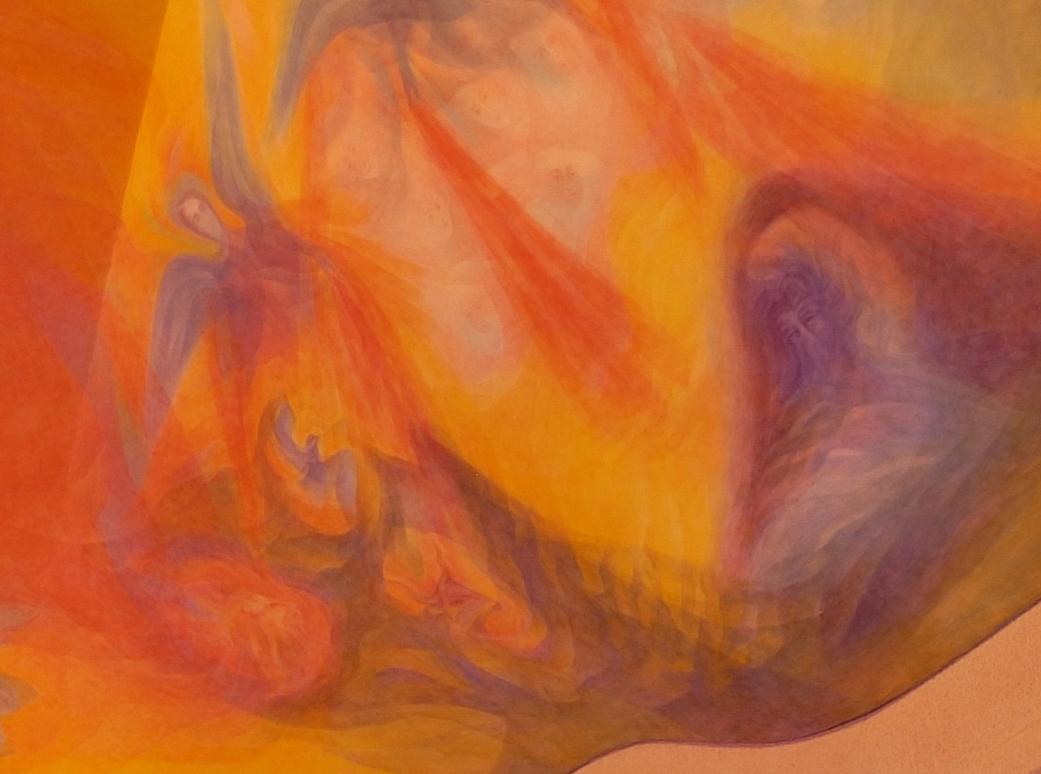
Boaz was the great-grandfather of King David - his name
meaning "strength, or it is in strength". Jachin was the high priest who assisted the dedication of Solomon's Temple - his name meaning "to establish" and united "stability".
"He cast two bronze pillars... he made pomegranates in two rows encircling each network to decorate the capitals on top of the pillars. The pillar to the south he named Jakin [Jachin] and the one to the north Boaz. The capitals on top were in the shape of lilies."
-1 Kings 7:15,18, 21,22
The head Mason, Hiram Abif, made the brass pillars.
In Qabalah, Jachin and Boaz are the names of the pillars of Mercy (J) and Severity(B). They appear in the Tarot deck on the High Priestess card.
"The Two Pillars. In these pillars is indicated the mystery of the part played in human evolution by red oxygenated blood and blue, or carbonated blood."
The two pillars represent the Tree of Life (oxygen- Hauschka calls biogen) and the Tree of Knowledge (carbon).
"In the fourth seal we see the Pillars, one of them planted on the sea, the other on dry land. These Pillars indicate the secret of the part played in human evolution by the red blood, rich in oxygen, and the blue of bluish red, rich in carbonic acid. The evolution of the I of man during the Earth epoch finds physical expression in the interaction between the red blood, without which there could be no Life, and the blue, without which there could be no Knowledge.
"Blue blood is the physical expression of those forces which give us Knowledge- forces which, however, taken by themselves and in their human form, are very nearly akin to Death. Red blood is the physical expression of Life- which however in its human form and by itself, could never give us conscious Knowledge. Together and in their mutual interaction they represent the Tree of Knowledge and the Tree of Life or the two pillars on the foundation of which the life and cognition of the I can grow and develop to that degree of maturity where at long last man will be fully united with the universal forces of the Earth.

"The Initiate foresees a future condition of mankind in which the Tree of Knowledge and the Tree of Life .... will be intertwined and united within man himself. At the present stage the aspirant to spiritual development should inscribe the message of the two pillars in his heart. Separated though they still are, they summon us to transcend the present state of mankind and to direct our footsteps to the place where through our widened consciousness the two will be interwoven - a secret that is indicated in the J-B.
"The verses inscribed on either pillar will bring home to us their meaning. Those on the first pillar relate to Knowledge, those on the second to Life itself. Thus at the former stage the formative, creative powers are revealed to man; at the latter he himself reveals them, magically.
"Progression from the mere faculty of cognition to that of magical activity in life is the significance of the transition from the power latent in the first inscription to that which is latent in the second."
- Occult Seals & Columns, Rudolf Steiner
"Men will extend their beings, as it were, in the course of times to come, identifying themselves more and more with the world; thus it will become possible to represent them in the form of the cosmos instead of the human form. This you can see in the fourth seal with its rock, sea and columns. What passes as clouds through the world today will offer its matter so that the body of a man may be formed from it, and the forces that today are with the Sun spirits will in future provide men with what will develop their spiritual forces in a much higher way. It is this sun force to which men are striving.
"Contrary to the plant that sends its head-like roots towards the earth's center, a man turns his head to the sun. He will ultimately unite his head with the sun and receive higher forces. This is to be seen in the fourth seal in the sun's face that rests on the body of clouds, on the rock and columns. In that future time, the human being will have become self-creative.

"As symbol of the perfect creation, the many coloured rainbow surrounds him. In the Apocalypse of St. John you can find a similar seal in which there is a book in the middle of the clouds. St. John says that the initiate must swallow this book. Here is indicated the time when men will receive wisdom not only outwardly, but will be penetrated by it as is the case today with food, when they, themselves, will be an embodiment of wisdom."
-Rudolf Steiner, Occult Signs & Symbols
We can acknowledge that there are two streams of thought in relation to
those laws which guide a man throughout the courses of his starry
travels in and out of time.
As he is drawn to and from various
experiences of existence, as he knows both the universal days and the
universal slumbers between, when he is swept into much causality, yet
effects many events upon himself; as he courses the ages depressed and
diffused only to always ever be replenished anew - there are two streams
of thought, in philosophical uncertainty, where it is suggested that
Man is a being, at this stage of his development, more 'driven' than
driving, whilst the other suggests that he is so driven that he drives.
In
consideration to the Holy Spirit from which all is empowered to be
driven and driving, we must firstly attribute all subsequent furtherance
and universal motoring to that. In a second consideration as to whether
or not men determine their own fates essentially, remarkably or
determinedly - we answer thus: yes and no:
- Insofar as Father God gives us the essential life
- Insofar as Christ has characterized us to make this life remarkable
- Insofar as the Holy Spirit has empowered us to live determinedly
Yes! But without these three, no.
-B.Hive
 It is simply
not possible to forcibly bring another to morality. The word morality
is not used in the social context or even in the common, but in the
principle of inert value that a man may discern through the heart for
himself.
It is simply
not possible to forcibly bring another to morality. The word morality
is not used in the social context or even in the common, but in the
principle of inert value that a man may discern through the heart for
himself.
A true morality is empathic and giving by nature, open,
demonstrative and perhaps even exaggerated in joy. (The true meaning
of morale - to keep them high.) Not morality in the depleted sense of
restrictive license; rather an internal discernment which corresponds
with God.
This form of discernment is acquired by
the cooperation of both the ego and soul of the individual (through
the means of the Arterial Self) and simply cannot be imposed....
Yet it is with this sense of correctness within, shall the
individual come to know whether or not he or she should reclaim their
existence and thus begin to heal.
-B.Hive
 How
does one temper the reality of grief within the world with merriment,
which is inhibited within the soul? (Merriment, not to be confused with
false merriment – joviality - but true merriment. Ho Ho Ho.)
How
does one temper the reality of grief within the world with merriment,
which is inhibited within the soul? (Merriment, not to be confused with
false merriment – joviality - but true merriment. Ho Ho Ho.)
Self-consciousness
provides for the spectator of the participating consciousness. This
spectator: the 'I Am Not', as you would have it, comes to
feel separate from the world which it views.....
That 'spectator' within all of us can be removed from criticism, and positioned above the general cares and woes - particularly in times of grief it shall remain there. This is not to say that this self-consciousness is not colored with preference or even emotion, but that there is a protection from overwhelming sorrow in this divorce from personality.
One can achieve this by knowing within, that no matter how gruesome, difficult, perilous or cruel conditions may present in the world, they are not permanently real, and nor do they affect us in higher realms after death. Our loved ones will endure, we shall endure, as we have done so all along. And there will be compensatory joys and much renewal, even though we may be 'open' to a seemingly treacherous existence in the here and now.
It is good for men to hear truth such as this. It is wholesome for the soul within, because truths have a way of resonating health. The soul does and will respond.
There is so little true consideration given today. This is why meditations upon 'simple' but potent truths are so lively and helpful. Contemplating truths which are essential to being, assist men with rhythms, development, order, and most importantly, returning to the awareness of that happy being which in truth is inside him.
-B.Hive
It is often supposed that in Bible times, grape juice inevitably fermented if kept for any length of time and that therefore whenever the Bible mentions “wine,” it is referring to the alcoholic beverage commonly called “wine” today. However, ancient civilizations had several ways of preventing fruit and fruit juices from fermentation, and thus were able to have non-alcoholic wine (grape juice) throughout the year.
One
method involved boiling the juice and reducing it to a syrup that could
later be diluted with water. Another was to boil the juice with minimum
evaporation and then immediately seal it with beeswax in airtight jars.
Drying the fruit in the sun and then reconstituting it with water,
adding sulfur to the fruit juice, or filtering the juice to extract the
gluten were also methods that would prevent the juice from fermenting.
These means of preservation were known to the ancients, who also
practiced boiling fermented juice to eliminate the alcohol. Referring to
reconstituting grape syrup to make grape juice, Aristotle, who was born
around 384 b.c., wrote “The wine of Arcadia was so thick that it was
necessary to scrape it from the skin bottles in which it was contained
and to dissolve the scrapings in water” (quoted in Nott’s Lectures on
Biblical Temperance, p. 80). The poet Horace, born in 65 b.c., wrote,
“There is no wine sweeter to drink than that of Lesbos; it was like
nectar . . . and would not produce intoxication.”

“The Mishna [a collection of oral Jewish traditions] states that the Jews were in the habit of drinking boiled wine” (Kitto’s Cyclopedia of Biblical Literature, vol. 2, p. 447). Naturally, this wine would be entirely free of alcohol as a result of the boiling, if not also from the manner of preservation.
In his commentary on the Gospel of John, Albert Barnes wrote, “The wine of Judea was the pure juice of the grape, without any mixture of alcohol. It was the common drink of the people and did not produce intoxication.” And Adam Clarke, commenting on Genesis 40:11, wrote, “From this we find that wine anciently was the mere expressed juice of the grape without fermentation. The saky, or cupbearer, took the bunch [of grapes], pressed the juice into the cup, and instantly delivered it into the hands of his master. This was anciently the yayin [wine] of the Hebrews, the oinos [wine] of the Greeks, and the mustum [wine] of the ancient Latins.” Clarke’s comments agree with the Scripture that declares “As the new wine is found in the cluster, and one says, ‘Do not destroy it, for a blessing is in it’ ”
(Isaiah 65:8, NKJV).
Source: http://www.bibleinfo.com/en/questions/what-are-historical-and-scriptural-facts-about-fermented-drinks-bible



_by_Phoebe_Traquair%2C_Mansfield_Traquair_Church%2C_Edinburgh.JPG)