According to the priest Rudolf Meyer the following statement was made by Rudolf Steiner long before his illness: “The Christmas Conference is not being taken up. There is still time. But if it is not taken up by the autumn, the Ahrimanic powers will launch their attack”.
The Stuttgart state attorney Dr. Bruno Kruger has testified that as early as June 1924 Rudolf Steiner said to him personally with firm insistence: “This impulse has failed. Come back to Dornach in October. Then everything will be arranged differently – including the situation in Stuttgart”.
A member who wishes to remain anonymous received from Rudolf Steiner, in response to a question about the Christmas Conference and its effects within the Society, the answer: the spiritual world allows nine months to see whether an echo comes from the members. If no echo comes, the impulses of the Christmas Conference have come to an end. When the nine months had passed, this member asked Rudolf Steiner about it again. He replied: “No echo has come. The Society has not taken up the Christmas Conference”.
The eurythmist Ina Schuurman testifies to having received personally from Rudolf Steiner the following statement, which she reports thus: “It was during a eurythmy dress rehearsal in the course of the Christmas Conference…. That Rudolf Steiner was walking past on his way from the auditorium, stopped in front of me and said: ‘Now let us hope that things can continue in this way for ten years’. In September 1924 there was again a dress rehearsal in Dornach…. When Rudolf Steiner came by and stopped in front of me. He said with great emphasis: ‘the Christmas Conference has failed’, and walked on into the auditorium.
There is also a communication said to have been received by Countess Keyserlingk after Rudolf Steiner’s death. Countess Keyserlingk had attained certain degrees in occult training. She writes as follows: “It was on the morning of Rudolf Steiner’s cremation, which I did not attend. The earthly body of the great Teacher was still laid out near to where I stood in the room of the carpentry shop, when close to me the aura of the beloved Teacher appeared.

"From this aura the instruction came that I should write. I took paper and pencil and from his presence came the following words – often I could not write quickly enough, then he stopped and waited until I had caught up with writing, as Rudolf Steiner had done on earlier occasions when he was dictating something to me: ‘My mission is ended. What I was able to give human beings at their present level of maturity, I have given them. I go away, because I found no ears able to hear the spirit-word behind the word. I go away, because I found no eyes able to behold the spirit-pictures behind the earthly pictures – I go away, because I found no human beings able to bring my will to realization. The Mysteries remain veiled or hidden until I come again. I will come again and unveil the Mysteries when I have succeeded in establishing in spirit-worlds an altar, a place of worship, for human souls. Then I will come again, then I will continue to reveal the Mysteries. Responsibility for my death is borne by those who have suppressed the culture of the heart. If human beings had gone through their hearts and penetrated into the depths they would have found the strength to fulfil the tasks of the present age’."
-Excerpts from General Renewal– or Illusion – of the Anthroposophical Society by Harald Giersch
A lecture held in Villingen–Schwenningen, Germany, on 19.01.2005
Giersch lecture
Like new-born Thoughts that glow and burn, suspended
In the vast pantheon of an Angel's mind,
All thought with love, all love with wonder blended,
We rest, and lo ! with vision unconfined,
See a DIVINELY HUMAN FORM who stands
Upon the sun, and holds a diamond rod.
It is a shadow from the face of God,
In-formed in quivering light.
Seraphic bands
Rise from the sun like many-colored rays,
Chanting around it melodies of praise.
"Know ye that Angel standing on the sun?"
A ministering spirit asks.
That look
The very look, the great, yet Crucified One,
Divine with love that Evil could not brook,
But turned with all its alien hosts and fled
Into the dark dominions of the dead
That look, whose light o'er darkened Calvary shone,
In-streams on me I know it know it well.
Not in man's heart doth thy dear likeness dwell,
O Lord ! alone.
'Tis imaged o'er the dome
That spans the sun, the bright imperial home
Of angel-nations, and forever shines,
Filling with seven-fold light those vast and tranquil
climes
Forever beaming there, the Day of day,
Whose glory clothes the orb with Love's perennial May.
Thou Sun, rejoice !
Ye goodly company
That round it throng, and fill with harmony
Of planetary life, the stellar space
Ye too rejoice, run brightening on your race !
Not from the sun alone ye draw your light :
The great Creator's image stands thereon,
Outpouring from your system's inner height
Such floods of glory, that the horizon
Rolls back an evening splendor on the morning.
Cease, cease, oh, mortal man, the idle scorning
Of the high mystery God in Christ ; for lo,
Yon sun His image to the stars doth show,
And all the stars from God in Christ derive
Their light, and from His life their nations live.
The origin of Beauty, Love, and Truth
Of light, life, motion, and immortal youth
Of form, of music, sweetness, and delight,
Flashes from God's own Image on my sight.
I feel the pulses of the Eternal Soul
In all my veins.
My thoughts within me roll
Like newborn planets, flushed with happy life.
My nature is at rest.
There is no strife,
No battle of contending forms above
Earth and its spheres.
-T.L. Harris, An Epic of the Starry Heaven
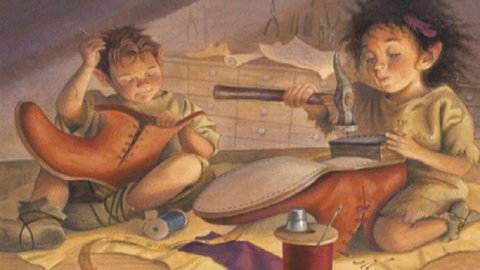
Do you remember the story of the shoemaker and the elves? How it came to be that master shoemaker had so much work to do that the little people would come to his aid, and as night fell the pieces would be cut and stitched and there were perfect shoes as ordered?
Quite so it happens that before we are born we have much assistance in the cutting and the piecing and the stitching of our many substances which will then unfurl; and for the main part it then becomes out of the angel's domain once the 'shoes' have been sent out into the care of the governing soul. There were a very special pair ordered for a princess as one story goes, that they were to be just so.
As remarked, the evolution of the body is not something that we have had a full hand in, but that rather, over many periods of change, we have gathered and equipped to ourselves the means to have the angels build with properties which are still to be refined and adapted and made perfect.
We may then know also that the question of disease and of weakness can be addressed in this way; that is to understand that our bodies as we have them today in the common world are belonging very much to a corporate whole, one which manifests illness from that whole, rather than in the particular.
The question as to whether or not we may relate specific physical problems to psychological and spiritual origin is perhaps best answered thus: of the many spokes there are to this wheel, one can choose any to begin from and attribute cause to such. If Man is held to be the central being (with Father God being most central and whole to him also) and out from Man we draw spokes which imply all that he has to his makeover, we can place them in part and in any order and turn the wheel, viewing the relationship one has upon another. It can be proven because of the fundamental principle of origin itself. That which is, is because is was, and that which was, is no more.
-B.Hive
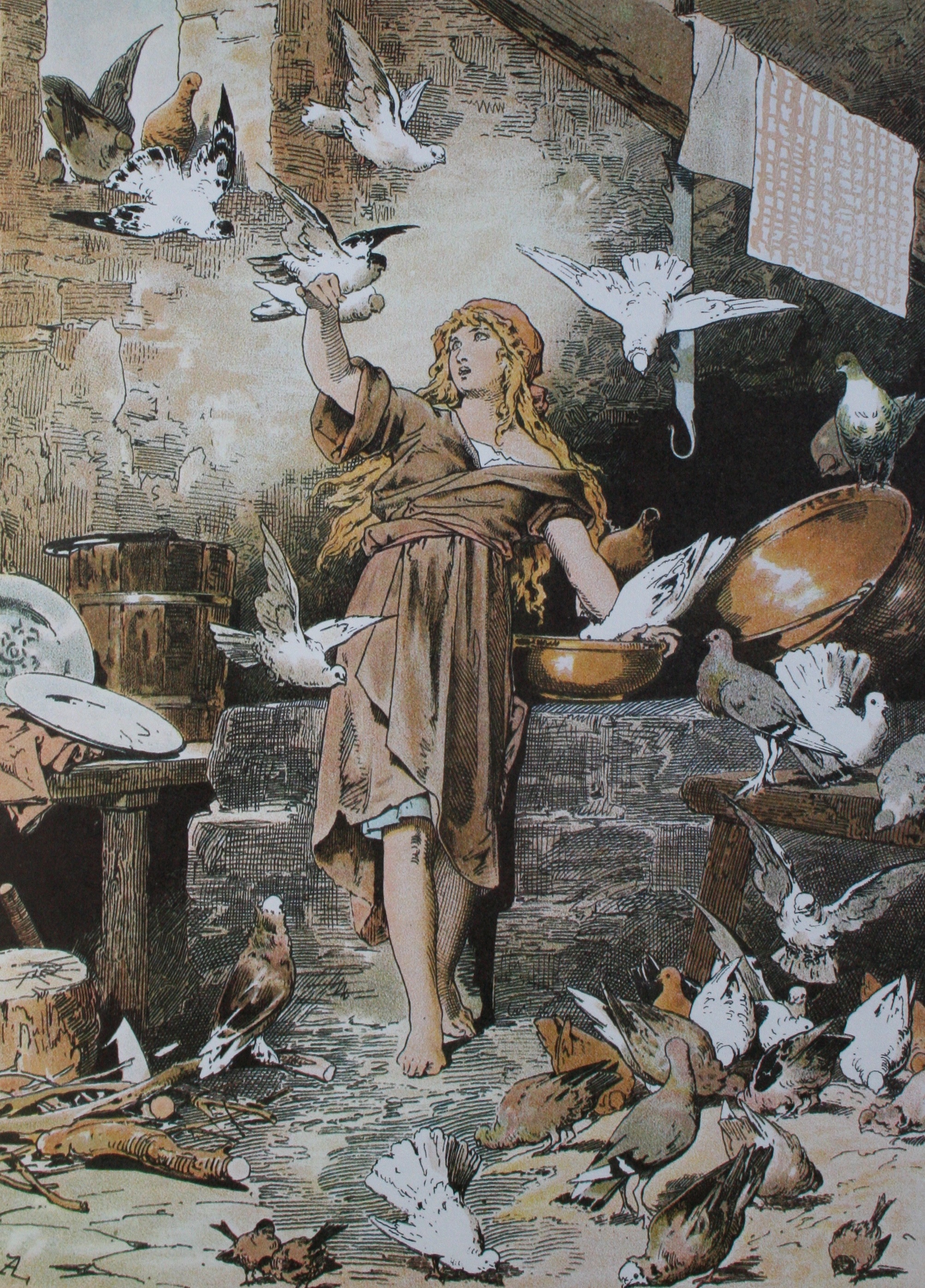
We begin with the picture of the hearth, as it was the sweet Cinders’ title to attend to the space in which the fires would burn heartily. Let this space be now her heart, which is given over to the household and to the world. She does clear away the ashes that she may prepare for the fires to burn again. In this there is truth that the soul’s love which inflames our inner spaces, graced by spirit and the life of the spirit, becomes choked with residue and the impulses subside, ever needing prompting back to life; for love and love’s passion, does ebb and flow in rhythmic obedience. There is the time in which we contain the fire, and the time in which we clean the hearth and prepare for its coming again.
Cinders had two sisters which dominated this story: Slovenliness and Wickedness. These sisters were unlike her in nature, bearing little or no resemblance to the child of the heart/hearth.
There was to be an occasion. A prince of the district was to hold a gala party that he may choose a wife to couple with. The sisters were eager to try their chances. The prince resembled all that a stately soul should be, in upright virtue, in strength and in capability. Therefore the acquaintance and subsequent mingling was desirable. For it can be said too, that when an individual truly meets in soul with another friend, then the qualities are shared. This is why we seek our Christ in combining, as best influence upon our humble natures.
Returning to the story: The haughty sisters mocked Cinders that she would wish to go to the Prince’s party. This party was the community host of all his invited confederates. This other soul has opened himself to the world at large, that he may seek out true commune in spirit, and so by inviting all of those who would accept the invitation (and others who would not) he has gone through the necessary obligations of being openhearted as well as openminded. For we must remember that all men are unknown to us, unless we truly know them. Should we really come to know them, then there is much love and affinity thereby. However, at the stage he was at, the Prince was seeking for his soul’s commune (that being the theme of this story) and so he was open to all, that he may find that which was especial.
The sisters are attributed to be quite ugly, but did do the best they could, dressing themselves in common finery, pretending that the outer appearance could conceal their sinful and lazy natures. In the outer world this does happen, that a man may feel uplifted, almost morally, by such clothes which are stately- however, it may be but a good guise and little more; particularly if the individual wears pride as well. And proud these two were, as they did strut with self admiration.
Here now, our picture of sweet Cinders is of rags, and she is overcome with the soot-black of ash upon her white skin. Why then should it be this way, that the pure of heart is portrayed so forlorn? This is because the soul is wanting and is not fulfilled. The closer to God that a soul does become, the more it suffers the world. It does also come to great happiness accordingly, however.
When the sisters had departed, Cinders fell into great upset at her self’s condition. If we are to review ourselves by comparison, we shall always find disparity; and so it is that the sadness came, but was answered in the appearance of an Angel. The Angel appeared to Cinders in beauty and in radiance, saying "You shall go to the party tonight, and I have come to help you."
That Cinders was to attend was ordained by her right to do so. The assistance that she was given is one that we all have. Although our angel’s presence goes unrecognized (for they are forbidden to make themselves known), in this special story our Cinders catches the vision of her intervening Angel and hears her speak.
Our physical presence which carries us through a lifetime in the world, is comprised of the service of both the animal and plant kingdoms. The transformation of pumpkin into coach was an example of this; as quite so, our physical bodies are just such an issue, wherein the dear contributory kingdoms serve to bear our souls by their constant reformation.
Cinders herself was clothed anew in the most beautiful of wraps, with also two crystal shoes upon her feet. In her case the outfit bore the resemblance of her inner nature, inasmuch as she was worthy to wear the finery. It was produced from the Angel herself, and of much better material than could be purchased within the world.
The crystal shoes are significant, for they are the connection she has within the world, and they represent the very clarity of being, true to the world in perceiving how it is for what it is. Shoes are our protection, and they may be of fashion as well as practical, however they are worn to soften our relationship with the world, and do cordon our selves from the immediate reality. By the wearing of crystal slippers, Cinders is still quite separate and protected from the tearing and scratching and skinning of coarse grounds, but is connected in the most refined way possible, as her perceptions of the world are nonetheless accurate – therefore she meets with the world in a consciousness of purity. Only she was entitled to wear them; and this was so because there was no selfishness to mark and mar the clarity.
The Angel made warning that there was but a definite time for which Cinders could make use of her equipment; that she must indeed return home before midnight, for then it should happen that all would return to how it was.
When Cinders made her entrance she appeared exquisite and quite obviously beautiful. The Prince immediately recognized this, and had come to see the quenching of his longings; for there was this other soul which was in likeness to his, and with space waiting there to fill; for she had gone in faith and with open expectation.
The love became a rapture and they danced together for the length of the night. But as the late hours did filter into the new morning’s day, Cinderella (Cinders now made beautiful), lost her strength in magic glamor as she remembered the Angel’s warning of returning back. She fled the court lest he catch her great indignity - leaving behind one of two crystal shoes.
That which the Prince had retained was rightfully now his to keep. For this is the way of soul commune, that there is always the remaining evidence and shared qualities; so one of the shoes became of his belonging. It is significant also because they both shared now a same connection with the world, and that he would come to know this to seek it further.
The Prince had no immediate way of finding his love directly. The powers of soul are illusive, and perhaps better understood to say that our comprehensions are many, with not one being so constant as to prevail over all. Continuance is always assured - that we pick up and return to this and that understanding, situation or soul. But change occurs in lively fashion, for without change, there becomes inertia leading to subsequent expiration; which necessitates a different change regardless. So he took charge to find his beloved, in whom he experienced a mutual knowing - but he knew not enough to simply recognize her by sight alone!
How often Christ has appeared to those who knew Him, but knew Him not! The way in which they could come to Him, once again, was not by this the visual appearance, and not by expectation born of themselves, but in being true to the spiritual reality, in meeting with crystal clear connection (the other half recollected), knowing that the love between you both verily made two sets of keys. You may go into the space of faith, into the heart, to find Him.
The noble search continued until the Prince happened upon the cottage in which Cinders took rest. Pushing their way before her, the sisters were determined to press their feet into the shoe - bleeding and crushing, bones cracked and toes looped off. But even so, there was no fit, and their false proof of soul-hood came to no real description. It was then that Cinderella was given the opportunity and so placed her foot in his half of the pair. Of course, the fit was perfect! It could not have been otherwise, and he knew her to be the one that he longed for.
Without the shoe he may have well bypassed this individual and kept up the lonely search. By appearance only we are ill-informed. Her costume given to her from the Angel, was one which showed only substance of soul; but it could not survive as visible within the outer world for long – it had to withdraw.
As it is said, the heart sees what the eyes do not; and contrariwise, the heart is a gentle informant. We can be peaceful in the proposition that others rarely see us as we are in truth. Although there most certainly will come the day when aspects are shared openly and obviously, for the time being there is a self protection for immature egos, that they develop a sense of self firstly; and then may go on to such sharing amongst selves in the greater outreach.
If we are aware of this, then we shall immediately lessen our penetrating influences upon others: those that impinge or dominate, or devastate the less developed individual. Once again it is a matter of understanding and attitude that people shall come to understandings with us and by us at the time when we cease to force ourselves upon them.
Our cloaks of humility are apparent when we are relaxed in our selves (and no, this does not mean inebriated or casual, or inconsiderate or sleepy). In spiritual definition it means that the inner tensions of want and will are divorced from our interest in another, and our love for their being prevails over personal desire. Our desire here of course, is that of being seen for who we are etc., and so we may forgo even that in order to meet them with love. This is not to say that we wear a cloak of falsehood or deception, for that kind brings sadness to both souls and no real convening.
Expressions of love from men and women, bring the gods their great happiness. We can only give love where it is chosen to be received; and if the space is not there for us to go into, there is no reality thus given it. And the space shall not be made if there is no faith there within that heart – as so cried Christ, for us to believe in Him.
The Prince did find his sweetheart and delivered her from the service of the sisters. The three were truly the one – our sweet souls are mocked thus by our own laziness and wickedness, which pretend to be beauteous and worthy of another soul’s consideration. When we have departed from these two undesirables, when we listen to our Angel’s counsel and pursue our heart’s destiny with clarity within the world, then it shall happen accordingly that we will find our destiny through faith, in believing of the greater love that shall one day come to reclaim us.
-B.Hive
There are many occurrences reported in the Gospels that pose riddles for present-day human beings. Rudolf Steiner has made their comprehension accessible to us through his spiritual research. Among them is an event that took place when Christ Jesus was taken prisoner in the Garden of Gethsemane.
In Mark 14, verse 51, we read: “And a youth was among His followers who wore a linen cloth about his body; and they seized him, but he left the linen cloth and fled naked.” In his lectures on the Gospel of St. Mark, Rudolf Steiner remarks: Who is this youth? Who escapes? Who is it that appears near Christ Jesus almost without clothing, and then slips away naked? It is the young cosmic impulse. It is the Christ that slips away and now has but a loose connection to the Son of Man....
Nothing is left to protect the new impulse; it has none of those elements with which the earlier times could envelop Mankind. It is the entirely exposed new cosmic impulse of earth evolutional. The fleeing youth is interpreted here as the cosmic impulse, the Cosmic Christ — as we learn in the further course of the lecture — who had been united with the Son of Man but then withdrew from him. Henceforth, He maintained only a loose connection with the Son of Man.
Only after the Resurrection did He reunite with him. This cosmic element had enveloped the Christ in the form of an aura during the three years of His earthly life, . . . an aura through which cosmic forces and cosmic laws descended to earth. . . Christ was surrounded by a far- reaching, mighty aura. This aura with its powerful influence was there because He was united with the souls of those He had chosen; and it remained so long as He was united with them. (l)
This inner bond of Christ with His disciples was to remain throughout the events of Golgotha. This was Christ’s great concern as He embarked on the path leading to His passion and death; for even the disciples had not recognized the cosmic spirit in Christ. Thus Christ made a final attempt to maintain the inner union, at least with the specially chosen disciples, when He led Peter, James and John to the Mount of Olives.
And on the way He becomes afraid. . . Why is the Christ sorrowful? He does not recoil from the Cross. This can be taken for granted. He recoils at the thought, the question:
“Will those, whom I have brought with Me, be steadfast at the decisive moment that shall prove if they can go with Me in their souls — if they can experience with Me all things, even to the Cross?”. . . This is the “cup” approaching Him. And He leaves the three disciples so that they may remain “wakeful”. . . Then He goes aside and prays: “Father, let this cup pass from Me, yet not My will but Thy will be done!”' This means: Do not let Me undergo the sorrow that I, as the Son of Man, will be left utterly alone. Let the others go with me.(l)
Yet, even the three chosen disciples could not remain wakeful. In their souls and in those of the other apostles, a strange condition of consciousness overcame them. They went about as in a dream for fifty days and only awakened from it when, at the event of Pentecost, the Spirit of the Universe descended upon them. They realized only then, in retrospect, what had occurred on Golgotha.
The cup had not passed from Him. Those whom He had chosen showed no understanding. Thus the aura gradually withdrew from the man, Jesus of Nazareth. The Christ and the Son of Man became ever more separated. Jesus of Nazareth became ever more alone toward the end of his life, and the Christ ever more loosely connected with him. Whereas the cosmic element was completely united with Jesus of Nazareth up to the moment when the “sweating of blood” takes place on Gethsemane, man’s incomprehension now loosens this con nection.... Although the cosmic element is still present, we find it joined less and less to the Son of Man. This makes the whole event so deeply moving.
And because the comprehension was not forthcoming — what did men attain in the end? Whom did they capture, sentence and crucify? The Son of Man! And the stronger their action became, the more the cosmic element withdrew, which as a youthful impulse was to enter earth life. It withdrew...
There remained behind the Son of Man, around whom now merely hovered what was to come forth as the young cosmic element. (1)
This cosmic element in the figure of the fleeing youth “is a spiritual, a supersensible element that became visible to the senses only because of the unique circumstances of that moment”. (1) It remained with the Son of Man, although loosely connected. And we see this youth again (in Mark 16, verses 5 and 6) when, at the early dawn of Easter morning, Mary Magdalene, with two other women, approaches the empty tomb and encounters a youth sitting there, clad in a white garment. Rudolf Steiner explains:
This is the same youth! Nowhere else in the artistic composition of the Gospels do we encounter this youth who slips away the instant that human beings condemn the Son of Man, who appears again after the three days are past, and who will henceforth be active as the cosmic principle of the earth.(l)
II
Who is this Son of Man, abandoned by the Cosmic Christ in the spirit-form of the fleeing youth? It would signify a complete contradiction to everything Rudolf Steiner says concerning the Mystery of Golgotha, if, from the above quotation, we were to conclude that it had been only the human being, Jesus of Nazareth, who as the Son of Man suffered the death on the Cross. After all, it is the unique significance of the Mystery of Golgotha that a god experienced death on earth.
Out of their midst, the gods had to send a being to the physical plane to experience something that gods otherwise cannot experience in the spiritual worlds. The gods had to send Christ to Earth . . . so He could learn the infinite agonies of men, agonies that for a god signify something totally different than for a human being.... A god had to suffer death on the Cross.(2)
As the only being of the spiritual worlds, Christ was to come to know death.... Hence, of all the celestial beings above man, Christ is the only One to have learned about death through His own experience. (3)
It had to be a divine being who would actually suffer human death on earth: Christ, who had entered the human sheaths of Jesus of Nazareth at the Baptism in the Jordan; who, united with Jesus as Christ Jesus, had then lived for three years on earth, and as an immortal passed through death on the Cross in the dying body of Jesus.
Rudolf Steiner stresses this fact again and again. Thus directly following his remarks about the fleeing youth, he speaks of the "judging, condemning, and crucifying of Christ Jesus,” (4) hence, not of Jesus alone. In another lecture he refers to Christ as “the One who dwelt on earth, was crucified as Jesus of Nazareth and laid in the earth, then appeared to His initiated disciples in a spiritual body.” (5) Indeed, how could we speak of Christ as the “Resurrected One,” if Christ had not actually undergone death?
Therefore, Christ could not possibly have separated from Jesus in Gethsemane but remained united with him even beyond death. The Son of Man is thus the Christ Jesus, the union of the two beings. The Cosmic Christ, however, must be something different. And indeed, Rudolf Steiner says that the youth, the Cosmic Christ, appeared “next to Christ Jesus” and “at the decisive moment separated, as it were, from Christ Jesus.” (1) Thus Rudolf Steiner distinguishes between Christ Jesus and the Cosmic Christ, the fleeing youth. Concerning Christ’s prayer on the Mount of Olives, he relates how Christ called Himself the Son of Man.
III
How, then, are we to understand the “Cosmic Christ”? Comparing many of Rudolf Steiner’s statements, we may conclude that a trinity of divine-spiritual Beings stands behind the Christ appearance on earth. First the Logos, the second principle of the Divine Trinity; then, His direct bearer and body of light, Christ, the Lofty Sun Spirit, the Ahura Mazdao of Zarathustra; and third, the leader of the hierarchy of the archangels.(6)
Mark describes the Sun Aura, the Great Aura, the Light Body, the Spirit Light that permeates the universe and that works into the being of Christ Jesus. Mark therefore begins with the Baptism by John, when the Cosmic Light descends. In the Gospel of St. John, however, the soul of this Sun Spirit is described to us, the Logos, the Sun Word, the inner aspect.(7)
Here, the Sun Word, the Logos, and then the Sun Spirit, the mighty Sun Aura, are clearly distinguished from the Christ in Jesus. Rudolf Steiner calls this Lofty Sun Spirit “a cosmic deity,” (7) the “leading Cosmic Spirit,” (8) and also “the leader and guide of all the beings of the higher hierarchies, an all-encompassing, cosmic, universal Being.” (9)
During the ancient Sun evolution, the Logos and, as its bearer, the Lofty Sun Spirit, had descended from cosmic heights to the sun to unite with the leader of the archangels, the regent of the sun. Thereby, this leader of the archangels became the bearer of the Logos and of the Lofty Sun Spirit, and thus the ruler of our whole solar system. (10) As a divine mediator, he served the Logos and the Lofty Sun Spirit during Their descent from the sun to the earth by incarnating in Jesus of Nazareth. This Christ-Archangel stood only two levels above the level of man, and in his divine nature was still relatively close to the human nature of Jesus, whereas the other two Christ Beings are infinitely far above man. They could not unite with Jesus directly in a bodily manner. The Logos, and the Lofty Sun Spirit, and the Christ-Archangel, termed “Christ” in equal measure by Rudolf Steiner, are united in triune manner, as it were. The knowledge of this trinity concerning the Christ phenomenon clarifies many otherwise incomprehensible statements by Rudolf Steiner.
Only in reference to the Christ-Archangel does Rudolf Steiner say that He was “physically incarnated as Jesus of Nazareth”, that He “actually dwelt among us in a physical sheath; that He was truly within a physical body.”(11) Therefore, if we read elsewhere that only “one— mark this well — one being of the divine-spiritual world descended to the level of dwelling in a human body within the sense world, living as man among other men” (12) then this being can only have been the Christ-Archangel. Through Him, however, the Logos and the Lofty Sun Spirit were linked to the human being, Jesus of Nazareth, due to Their Oneness with the Christ-Archangel. Thus, it can be said of Them, too, that They took possession of the body of Jesus and “became flesh” in Jesus, spoke and worked through him and participated in the event of Golgotha in mysterious ways veiled from us.
IV
The Logos and the Lofty Sun Spirit are the actual bearers of the cosmic element that was to enter earth evolution as the new impulse of the future. This cosmic element enveloped Christ Jesus like a protective aura, safeguarding Him from His opponents so that fundamentally, Christ was active in such a manner that nothing could be done against Him.... Whereas earlier, the Cosmic Christ had extended His influence into the temple, spreading the most powerful teachings, and nothing had happened; the soldiers could now draw near, when Jesus of Nazareth stood in a much looser connection with the Christ (1)

Only after the protective aura had left Christ Jesus, could the soldiers lay hands on Him. The Christ-Archangel in Jesus could not have protected Himself; because of His union with the bodily sheaths of Jesus, He had become human like other men. Rudolf Steiner once actually speaks of Christ’s “becoming Jesus.” (13) Beginning with the Baptism in the Jordan, in unimaginable agony the Christ Being descended ever more deeply into the body of Jesus, which increasingly wasted away under the power of the Christ force penetrating it like fire. And with His becoming human, Christ increasingly lost His divine power.
The Christ Being had to experience how the divine power and force increasingly vanished as He became one with the body of Jesus of Nazareth. A god gradually became a human being.
Like a person who in unceasing suffering watches his body waste away, so the Christ Being saw His divine substance diminish. As an etheric Being He increasingly came to resemble the earthly body of Jesus of Nazareth, until He became so similar that He could actually feel fear like a human being.... The miraculous divine power left Him.” (14)
As a divine Being in the abundance of His divine powers Christ had entered His earthly incarnation of three years’ duration with the Baptism in the Jordan. At the end, only weak human forces were left at His disposal. For a time, the Christ in Jesus, the Christ-Archangel, had to relinquish his divine powers in the course of becoming human, so that He could suffer death on the Cross as a god become man. And the Logos and the Lofty Sun Spirit had temporarily to withdraw Their powerful cosmic forces from Christ Jesus so far as external effects were concerned, so that He could be apprehended by the soldiers.
It must have been the forces of the Logos and of the Lofty Sun Spirit that withdrew from Christ Jesus as the “Cosmic Christ” in the image of the fleeing youth. After the Resurrection of Christ Jesus, They then reunited Their cosmic forces with the divine forces of the risen Christ-Archangel in order henceforth to live in Their triune Oneness as the Spirit of the Earth in human souls on earth.
- By OSKAR KUERTEN (1886-1973)
From Mitteilungen aus der anthroposophischen Arbeit in Deutschland, Easter 1971. Translated by Maria St. Goar.
Notes:
1. Sept. 23, 1912: The Gospel of St. Mark, lecture IX.
2. April 17, 1912: The Three Paths of the Soul to Christ, lect. II.
3. April 27, 1913: Life Between Death and a New Birth.
4. Sept. 24, 1912: The Gospel of St. Mark, lect. X.
5. April 24, 1922: Man 's Life on Earth and in the Spiritual Worlds.
6. For more details see Oskar Kuerten: Der Sonnengeist Christus in der Darstellung Rudolf Steiner's, Verlag Die Pforte, Basel 1967.
7. Sept. 12, 1910: The Gospel of St. Matthew, lect. XII.
8. June 27, 1909: The Gospel of St. John, lect. IV.
9. Aug. 21, 1911: Wonders of the World, Ordeals of the Soul, Revelations of the Spirit, lect. IV.
10. June 12, 1912: Man in the Light of Occultism, Theosophy & Philosophy, lect. X.
11. June 6, 1907: Theosophy of the Rosicrucians, lect. XIV.
12. Aug. 28, 1909: The East in the Light of the West, lect. VI.
13. Aug. 24, 1918: The Mysteries of the Sun and of Threefold Man, lect. I (Typescript).
14. Oct 3, 1913: The Fifth Gospel, lect. III.
[Easter]