Translate

Thursday, February 16, 2012

Upon the Subject of the Saturation of the Earth through to the Inner Core

 Descent into Hell, Copperplate print by Pieter van der Heyden on a drawing by Bruegel

 [The below remarks by B.Hive, relate to questions arising from Robert Powell's Christian Hermetic Astrology, on our Christ's present journey through the inner Earth.]
 
THERE is a picture of our Christ supporting a massive rock ledge, with all of his might and intent that one by one folk may issue forth from their captivity and out into freedom. That were it not for this solitary being, those souls would be still held within those dark and unloving recesses.

There are three points to be made here:

  1. The souls and the beings which are transformed and thereby freed by the Christ are not as overcome, but released. There is a slight but grave distinction in perspective here. As He makes His way throughout the lower spheres He does so overcoming only those trace elements of decadent residue, of which the beings are made free of.
  2.  The process, if you will, takes time because Christ meets every soul and being who inhabits the realm naturally - He is before each and every one individually and completely. As you can begin to imagine this actually takes more than a considerable time; much more, and is in point of fact, largely accomplished outside of our time for the greater part. Our time period does not relate accordingly to what needs to take place and is 'doing' in those altered regions.
  3. There is little said, and for good reasons, about those parts of a man which are intimately associated to him, which abide in the nether-regions of the lower spheres. Each layer in is as an actual sphere - picture spheres within spheres. The outer Earth is this too, whilst a greater one extends also out from that. However, every soul of Man has a part/portion/parcel of self actually held within each sphere, higher and lower, relative to him. This is not even taking into account those beings too, which are primarily connected with him in time, to his actions past and to the fulfilling of their future design. No, this is moreover relating to Man's earthly warranty, his 'toes' which extend into the very depths; and for Christ to save the whole Man, these 'toes', these lower limbs of Man's being, must be loosened from the mud and rock and brought up as each sphere amalgamates within another.

Quote from Robert Powell's article SUB-NATURE AND THE SECOND COMING:
Concerning the lost Kingdom of the Mother, it is interesting to consider Rudolph Steiner's words to Countess Johanna von Keyserlingk at the end of the Agricultural Course (Whitsun 1924), at which he laid the foundations for a new and conscious relationship to Demeter through a spiritually-based agriculture (biodynamic farming):

Rudolph Steiner was good enough to come up to my room, where he spoke with me about the Kingdom in the interior of the Earth. We know that at the moment Christ's blood flowed onto the Earth a new Sun-globe was born in the Earth's interior. My search had always been to penetrate the depths of the Earth, for I had seen raying up from there an Earth-core of gold, which Ptolemy designated as the "Archetypal Sun". I could not do otherwise, again and again, than to bring this golden ground into connection with the land of Shamballa, of which Rudolph Steiner had spoken. He had recounted how this land had disappeared from the sight of human beings and that Christ would open the door to those human beings seeking it, to lead them to the "sunken, fairy-tale land of Shamballa" of which the Hindus dream . . .
 I asked Rudolph Steiner, "Is the interior of the Earth of gold, originating from the empty space within the Sun, actually belonging back there again?" He replied, "Yes, the interior of the Earth is of gold." For the sake of certainty, I asked him further, "Herr doctor, If I stand here upon the ground, then beneath me, deep in the interior of the Earth, is the golden land. If I were to attain to freedom from sin and were to remain standing in the depths, the demons would not be able to harm me and I would be able to pass through them to the golden land. Is this so?" He replied, "If one passes through them together with Christ, then the demons are unable to harm one, but otherwise they would be able to destroy one!" He added the significant words, "However, they are able to become our helpers. Yes, this is so. The path is right, but it is very difficult".

Saturday, November 12, 2011

Secret Matthew Gospel

Is the canonical Gospel of Matthew a genuine reproduction of Matthew's original autograph? Apparently not.

In SOD - Son of Man,
page 46, Samuel F. Dunlap, quotes Jerome:
Writing to the Bishops Chromatius and Heliodorus, he complains [Jerome] that "a difficult work is enjoined, since this translation has been commanded me by your Felicities, which St. Matthew himself, the Apostle and Evangelist, DID NOT WISH TO BE OPENLY WRITTEN. For if it had not been SECRET, he (Matthew) would have added to the evangel that which he gave forth was his; but he made up this book sealed up in the Hebrew characters, which he put forth even in such a way that the book, written in Hebrew letters and by the hand of himself, might be possessed by the men most religious, who also, in the course of time, received it from those who preceded them. But this very book they never gave to any one to be transcribed, and its text they related some one way and some another.

This in turn is quoted in Isis Unveiled by H. P. Blavatsky, volume 2, chapter 4.

From this quote it is difficult to believe that Jerome was not in possession of the authentic Matthew - Chaldee language, Hebrew letters.
I did track down the original source of the above quote.
It comes from the preface to a "Pseudo-Matthew". Now whether or not the the Gospel is "pseudo" or not may be a matter of opinion; and whether Jerome's letter is real or not might also be a matter of conjecture. By the same token, we might question whether certain documents have been deemed spurious purely because they don't fit in with the status quo.

From the Wiki on the Gospel of the Nazarenes:
higher criticism argues that the canonical Gospel of Matthew is not a literal reproduction of Matthew's original autograph, but was rather the production of an unknown redactor, composed in Greek posthumous to Matthew. This aligns with Jerome's assessment, in which he stated, "Matthew, also called Levi, apostle and aforetime publican, composed a gospel of Christ at first published in Judea in Hebrew for the sake of those of the circumcision who believed, but this was afterwards translated into Greek, though by what author is uncertain."(Jerome, Lives of Illustrious Men, Chapter 3) 
Also on the above wikipedia entry, is a list of variances between the Canonical Matthew and the extant reconstructed text of Gospel of the Nazarenes.

So what proof do we have that Jerome didn't write the introductory letter that appears in the Gospel of the Pseudo Matthew?


 More about this Gospel:
"A narrative of the flight into Egypt is adorned with poetic wonders. The dragons, lions, and other wild beasts of the desert adore the infant Jesus. At His word the palm-trees bow their heads that the Holy Family may pluck their fruit. The idols of Egypt are shattered when the Divine Child enters the land. The "Gospel of the Nativity of Mary" is a recast of the Pseudo-Matthew, but reaches only to the birth of Jesus. It is extant in a Latin manuscript of the tenth century."

Tuesday, November 01, 2011

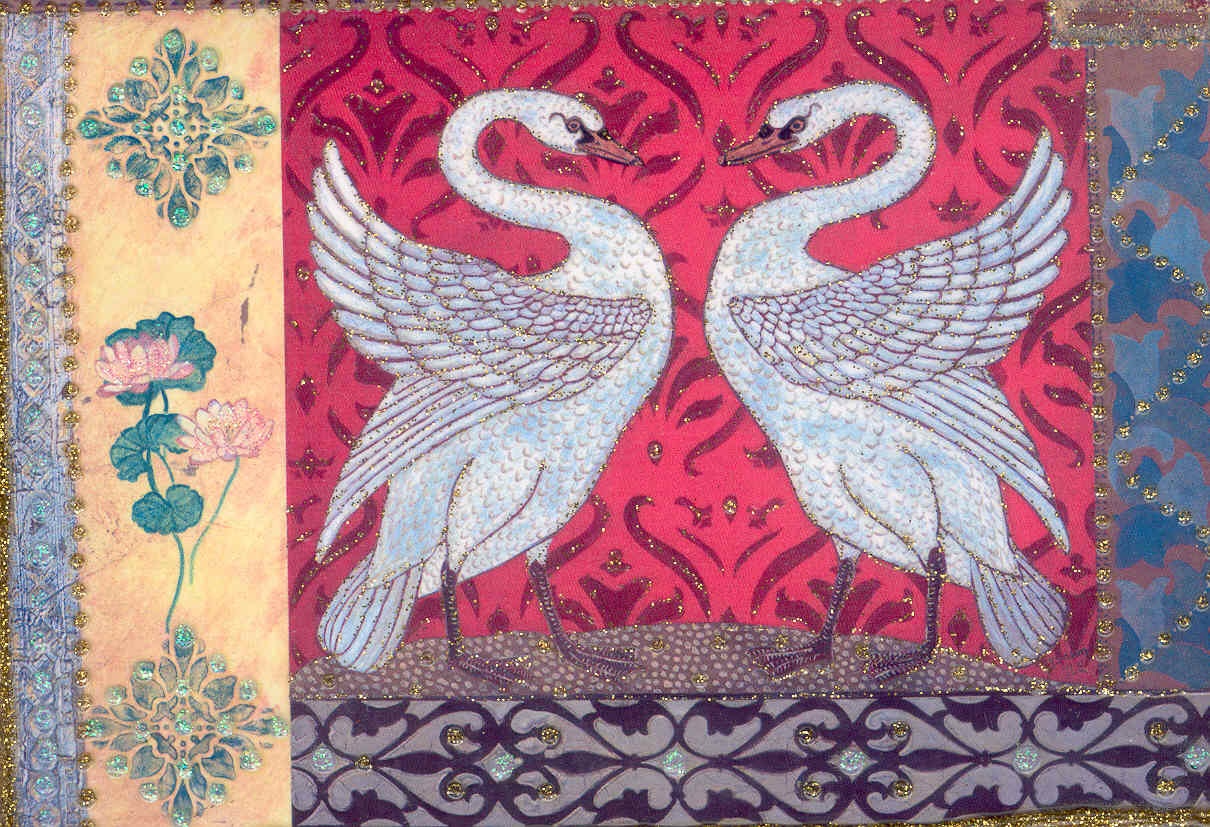
Swan Initiation


There is an expression "swan song" which means death or dying. This expression comes from the thought (Middle Ages) that swans sung before they died. It is a clue to the Swan level of initiation.

In the writings of Basil Valentinus, the Swan represents the third level of initiation - Raven and Peacock being first and second. In this level Inspiration as the Divine Word, the harmony of the Spheres, sounds forth.
 
"In the third degree he meets death and must sing the Swan's song. He then dies to everything earthly."
 
- Notes from Walter Stein's The Ninth Century
The next stage, is often shown as The White Swan. Now the alchemist begins to experience the inner world as being light filled - the initial inner brightness which is often erroneously mistaken for true illumination. This is merely a first conscious encounter with the etheric world, and in comparison with physical sense experience is for many souls so overpowering as to be pictured as bright white light. The alchemical tradition recognised this and symbolised this stage as the White Swan. The swan is a bird which is rarely seen in flight, but rather swimming upon lake or river, gracefully moving on the surface of water- in soul terms, on the soul's surface, its etheric interface with the physical.

-Adam McLean, The Birds in Alchemy

More on the Swan as the Aum, taken from:
The Voice of the Silence by H. P. Blavatsky

I found this interesting, that the parts of the bird were "parts" of the AUM. I wonder if this was pictured in meditation?:
"Kala Hamsa, the "Bird" or Swan. Says the Nada-Bindu Upanishad (Rig Veda) -
"The syllable A is considered to be its (the bird Hamsa's) right wing, U, its left, M, its tail, and the Ardha-matra (half metre) is said to be its head."

"Some Sanskrit mystics locate seven planes of being, the seven spiritual lokas or worlds within the body of Kala Hamsa, the Swan out of Time and Space, convertible into the Swan in Time, when it becomes Brahma instead of Brahma (neuter).
A Yogi who bestrides the Hamsa [Swan] (thus contemplates on Aum) is not affected by Karmic influences or crores of sins."
Through contemplation on the AUM the student passes from the world of images to the world of God - the Archetypes.

From the Contents Rudolf Steiner's of 

Esoteric Lessons Part III: Berlin, 12-21-'04


AUM, I acknowledge myself or I am: A. 

I acknowledge mankind or man is: U. 

I acknowledge the Godhead or God is: M. (Or I acknowledge life: M)

Feel responsible for every thought, feeling and action. Every moment that we experience in this way brings us forward a little. What would I be without other human beings? Helpless. Streets are paved by others. When I get up in the morning people have already worked for me. My karma is connected with that of other men. I may have been an accomplice to a murderer because I didn't improve him in a previous life. One man's gain is someone else's loss. Teachers taught me. People worked for me from the moment I was born. So do good for all mankind.


Saturday, October 15, 2011

Kundalini & the Ego


Dr. Steiner did give Kundalini exercises to some of his pupils- this was only after a thorough preparation. Working with the Kundalini is part of initiation, only the Western path is a top-down approach (this being the only way true freedom is assured).


H.P. Blavatsky was of course, firmly against any dabbling in Kundalini exercises- as she was against any "sitting for yoga".

Meher Baba and Goethe are given by Tomberg as examples of two paths. We do not admire Goethe because he was the ideal human being but because of the inner power of his striving after the realization of the gods' (Christ's) ideal. Inner striving after repeated failure is the real test of a man, the success of entering Nirvana is not.

We strive towards the temple which Rudolf Steiner speaks of, only by working through our many imperfections.

Meher Baba was not just someone who applied some yoga exercises and became "enlightened". Folk did undoubtedly experience divinity whilst in his presence. There was a spiritual purity around the man - he was a God-man. Considering he took a vow of silence, he must have had more going for him than just spiritual instructions.

His gift, one would say, was oneness with Father God, rather than union with Christ. Though the Gospel says no one comes to the Father but by Christ, there are paths which bypass Christ. This freedom is also a gift of Christ - they use Him "passively".

Tomberg goes into detail about this as well. It is only on Vulcan that the human being will reach its highest ideal of standing only before Father God. So that is a long way off, and by bypassing all that development we miss out on that great ideal which has been the Divine Plan all along.

Those who choose the Luciferic "lifestyle" will not be obliterated. But some extremists will have suicided out from humanity and become less than human. Dr. Steiner talks about them having dragonlike forms with animal heads.

The trouble with all of this is, that right now humanity is not strong enough to resist the temptation of that blissful existence in favor of the work to be done here on earth. That is why we have to be shielded from it in the after death state.

The Christian initiate enters into Nirvana because of need, not because of want. It is a process of activity and rest which is consistent throughout the Cosmos. All activity or all rest are extremes which both lead to decline.

Interestingly, the original purpose of hairshirts was to keep the mystics from disincarnating while they were experiencing times of great bliss.

Most definitely, the ancient Indian philosophy is extremely complex - and not all are in agreement. Not all the Eastern paths are of the "egoless" way - and we know the dangers of egotism. We all know cases of the spiritual student who has become overcome with egotism - which is really the result of a weak selfhood. An extreme of this is when we think that we are totally independent. This is the temptation of turning stones into bread. Normally our need for food tells us that we are not so independent, that the world is not a construction of own.

Rudolf Steiner elaborates on this in his Gospel of Matthew lectures:

A stubborn factor arising in one who is striving for esoteric development is the tendency to occupy himself solely with his own personality. It is precisely in those who want to find their way into the spiritual world that the habit is so often found of loving to talk about their own cherished personality, concerning themselves with it every moment of the day. Whereas in other circumstances people may deliberately refrain from adopting this attitude when they make efforts to develop or perhaps when they first become anthroposophists, they now begin to pay great attention to their own Ego; and then illusions arise on all hands, illusions from which they were formerly diverted by the ordinary demands of life.

Why does this happen? It is because such people are incapable of coping with what rises up from their own inner nature. They are utterly at a loss to know how to deal with what is happening in themselves. Formerly they were alert and readily attracted by the external world; now they are diverted to their own inner world and all sorts of feelings and emotions that were within them begin to rise up.

Why is this? What such a person really wants is to be an 'I', an Ego, entirely independent of the external world. But then he often falls into the error of wanting to be treated like a child who is told clearly what he must do. He wants to be anything rather than a man who sets his own direction and aim in accordance with what esoteric life teaches him. He has not yet begun to reflect about it, but he has the feeling that dependence upon the external world is a disturbing factor, especially when he wants to be absolutely untrammelled and give all his attention to the dictates of his own egoism.

But there is one fact, trivial though it may seem, that prevents him from detaching his bodily life at least from the surrounding world; this fact is that human beings are obliged to eat. It is a trivial fact but it is fatally true. We can learn from it how powerless we are without the world around us. It is a trenchant example of our dependence upon the surrounding world without which we could not live; we are really like a finger on our hand: if we cut it off it withers. A quite trivial consideration can therefore show us the extent to which we are dependent upon the surrounding world.

Egoism at its highest pitch may take the form of the wish: If only I could become independent of the surrounding world; if only I were myself capable of conjuring into existence by magic that which as an ordinary human being I need in physical life but which causes me to be so strongly aware of my dependence upon the world around! Such a wish may actually arise in those who are seeking to attain Initiation. Even hatred may be aroused by the realization that one is dependent on the environment and incapable of conjuring the means of nourishment into existence by magic. It seems strange to say this, but although wishes that soon arise on a small scale when a person is striving to develop appear paradoxical, in their extreme form they become downright absurdity. A man is usually quite unaware that he has such wishes. In point of fact no human being has them so strongly that he is deluded into claiming the power to create food by magic, to sustain life, by something not derived from the external world, from Malkhut. But in an extreme case someone might believe: If only I were able to live so entirely in my astral body and Ego that I could rely for my needs entirely on my own wishes, I should no longer be dependent on the surrounding world!

This form of temptation does arise. And in the case of the One who was to undergo it in its greatest intensity, it is characterized by the saying that the Tempter confronting Christ Jesus bade Him turn stones into bread. This is temptation in its extreme form. The descent into a man's own inner being is described most wonderfully in St. Matthew's story of the Temptation.

The second stage comes after the aspirant for Initiation has penetrated into his astral body and is confronted by all the emotions and passions that could have made him into an utter egoist.

Perceiving all this, instead of resisting and overcoming it, a man would like to cast himself down into the etheric body and physical body. This is a situation that may well be described as hurling oneself into the abyss. And this is how it is actually described in St. Matthew's Gospel: man casts himself down into what he has not hitherto been able to spoil to any considerable extent, namely, the etheric and physical bodies. But the passions and emotions must first have been overcome. The Christ Being knows this and facing the Tempter, having overcome the forces by His own power, declares: Thou shalt not tempt the Being to whom thou should'st surrender thyself!

end of quote

Friday, October 14, 2011

The Goals of the Student of Yoga

Below is really the best article by Valentin Tomberg on the differences between Indian Yoga and the Christian paths:

Just as it was necessary within the social order of India to build a bridge by means of the caste system between material man and spiritual man, and as it was necessary in Indian thought-life to bridge through theory the polarity of the abovementioned principles (Purusha and Prakriti), so in Yoga it was a question of actually treading the path which leads from the realm of matter to that of spirit. And that pathway is certainly taken, and many take it even today in those parts of the world.

Regarding Yoga now from this point of view - that it is not just a theoretical world of ideas, but a practical ordering of the relation between spirit and matter - there arises the question as to the manner in which this relationship is governed. We are faced with the question: What does the student of Yoga actually want to achieve ? What aim does his soul have in view ?

The goal of the Yoga student is to be freed from the bonds of the body, and essentially Yoga technique employs methods for breaking these bonds. These consist of a system of exercises along with a certain way of life which call forth changes in the human being, taking him further in the direction of this goal. The transformations striven for by repeated exercises and the definite life style of Yoga result in the formation of a kind of stream of forces which come from below and move upwards in the human organism; from the lower body up into the head.

This stream of forces moving from below upward (the so-called "Kundalini Fire") reaches the brain and crown of the skull and penetrates through them, causing consciousness to be loosened from the body and the experience of the desired state of freedom from earthly bonds. In this way through Indian Yoga, experiences are sought which arise in connection with a freeing from the body. This striving is a striving after freedom but in the sense of a freedom from the earth.

The practical aim of Yoga actually stands in polar opposition to the ideals of the representatives of Christian European culture. These representatives of the profound Christian spiritual life revealing itself in the past in the form of Rosicrucianism, strove also toward a practical goal, yet their goal is entirely different from that of Indian Yoga. For them the important thing is not to be freed from the earthly element, but to redeem everything earthly from evil.

The idea which forms the basis for this striving is not the opposition between spirit and matter, but rather the opposition between good and evil.

Christianity, not as a philosophical or theological teaching, but as a active spiritual force in the world, proceeds from the idea that evil has penetrated into the world and that error, sickness, and death are its results. Therefore it cannot be Christianity's task to retreat from that realm, but rather to conquer the evil which has given cause for error, suffering and death.

Before Christianity stands the lofty and distant goal of conquering death itself, not in the sense of fleeing into that realm where death no longer exists, but of conquering it in that place where it unfolds its greatest power. The victory over death in the realm of earthly life itself that is the goal of true Christianity. However, this goal must be reached through victory over evil. It is not a question of fighting against matter, for matter and nature are not in themselves evil. Rather they can be seen as victims of evil. The task of man, therefore, is not to wrestle with nature in order to free himself from her, but to struggle to purify her and set her free.


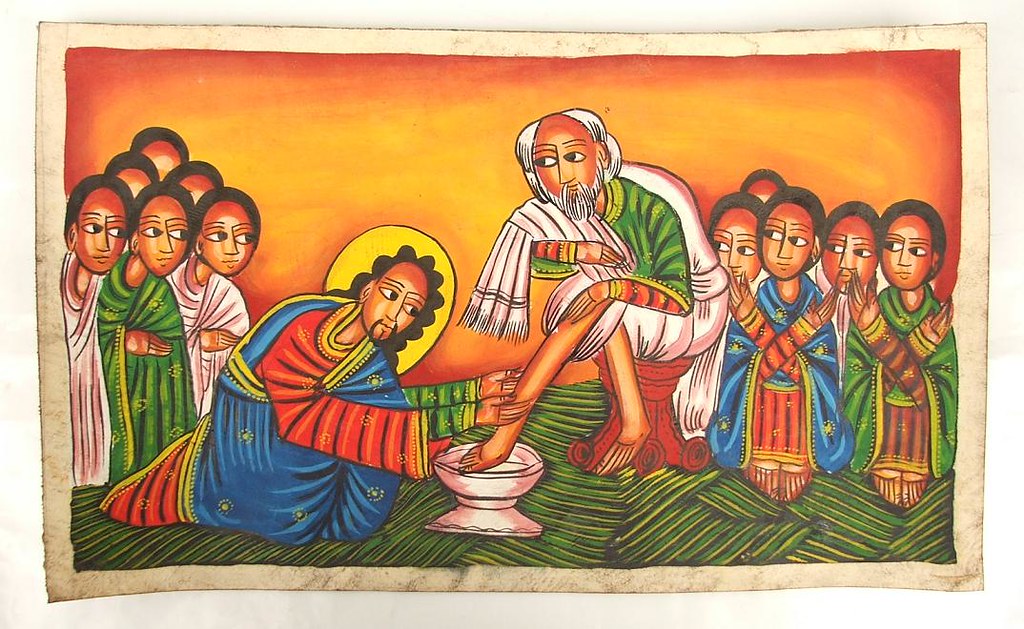
This goal of true Christianity finds expression in the image of the Washing of the Feet from the sublime Gospel of St. John. There Christ bends down to the lowly and even to the lowest of the low, the feet of which He washes. In this image, the idea is expressed that the Christ impulse has the task of enabling the 'low' to be purified: by going down oneself into the lowest regions of being in order to ennoble them.

Now there is nothing, either in man or nature, which cannot be transformed. Among the ways that this striving came to expression was in the misunderstood and misused Alchemy, widespread in Europe in the Middle Ages. The alchemists were wholly filled with the wish to transform the 'lower into a higher', and were convinced that this was just as possible in the case of metals and other substances as with the human soul forces.

Their efforts to transform base metals into precious ones were actually expression of a deeply inward permeation with the reality of the Christ Impulse. They strove to apply the great principle of Washing of the Feet, even in material processes in their laboratories ; and they did this - the original, true alchemists - because they had the actual experience: it is possible to transform the 'lower into the higher'. They expanded their inner experience into the outer realm of physical substances and forces.

The Alchemy of the Middle Ages is merely one especially conspicuous example of the working of the Christ impulse in man. There are many such examples. In all of them the main thing is that they give expression in various ways to the principle of the Washing of the Feet. This principle is actually the spiritual-moral foundation for any true Christianity. It is especially the basis of Christian Rosicrucianism.

While the objective of Indian Yoga is to create a stream of 'fire power' from below upward in the human organism with the purpose to experience the liberation of one's own soul, so in Christian Occultism the MAIN OBJECTIVE IS TO CREATE A STREAM OF 'LIGHT POWER' WHICH WORKS ABOVE DOWNWARDS. Meditation and other spiritual exercises of Christian Occultism have the task to allow the light which is kindled in the head to stream downward so that the unconscious life of human urges and instincts may be illuminated and ennobled. And the purification of human nature is the beginning of the purification of all Nature: that is, the beginning of the conquest of evil in the world.

Today, when many writings on occult themes bring much knowledge to men, it is necessary that every European who has an interest for true spiritual life should carefully consider the choice between the ideals of Indian Yoga and the ideals of the more deeply penetrating Christian spiritual direction - between "self-liberation"and "Washing of the Feet".

end of article

(My Caps)

Valentin Tomberg elaborates further -  from his book Inner Development:

This slumbering force is to be awakened. [Why is it slumbering to begin with?]
If awakened it is channelled upward into consciousness and superconsciousness, thereby creating a current that, rising out of the region of the abdomen, ascends as far as the top of the skull, whence it escapes into the outer world. This is a condition of ecstasy in which the soul rises to the greatest heights of the Divine and becomes a Mahatma....

If the slumbering power of fire would be awakened, it would ascend in serpentine movements and then leave the body. It is what the Indians designate as the thousand-petalled lotus flower, the crown center of the head, that is here brought into movement, producing a multitude of upward-flowing streams leaving the body....

But in fact what really happens is as follows. The higher expelled soul life ascends upward, the lower it falls later on - like rain - into the sphere of the Ahrimanic. The physical natural phenomenon of rain has this process as its spiritual archetype. If an individual ascends, like a cloud, to dwell in the heights, then there occurs after a certain time a fall into the region of Ahriman. Thus Ahriman captures the Luciferic. That is karma. But the impulse lying hidden in this Yoga is not simple that one can merely say: human beings wish only to be freed from life's vale of tears. We do wish it, but this is not the essential thing.

Let us try to understand what inner motives really lie behind the pursuit of Yoga.

When in the life after death one has passed through the cosmic midnight hour, the midpoint in the soul's path after death, then one stands before the possibility of a definite temptation. One says to oneself: "I live in the spiritual; spiritual light surrounds me. It would be possible for me to incorporate into this spiritual light everything that I bear within myself, to unite with it so that everything in me that is imperfect would be transformed into perfection."

This is the Luciferic temptation. It means inwardly to break away from, and refuse, the whole further development of humanity. In the cycle of lectures Rudolf Steiner gave in Vienna in 1914, The Inner Being of Man and Life between Death and a New Birth, you will find a description of these matters. The point is that a temptation can be so great that a human soul cannot withstand it. Such a temptation is therefore concealed by the gods, but nevertheless it is effectively present in the world. The element of temptation here does not consist in one's being offered the possibility of, say, dominion, or of realizing evil intentions, or the temptation of egoism in the worldly sense; no, the possibility offered is that of remaining pure and holy in the spiritual world. But in that case what is imperfect- and yet, as potential perfection, is still present in human nature-will not be developed, even if what is already developed in human nature were to remain forever in the light of purity and holiness. The temptation, then, is to renounce the great ideal of the future. In return, one can attain to a high degree of beauty and light in one's being, insofar as this is now developed.


Thus every human soul stands at one time before the choice of becoming wonderfully holy or else at some time in the future-by working through many, many imperfections - of attaining a far-off ideal, wherein all undeveloped faculties implanted in human nature by the gods will come to fruition.

Rudolf Steiner speaks of the "temple" of humanity's future as the image of the ideal human being. In the state after death, the soul sees this temple and is so inspired by the temple's light that it enthusiastically makes decisions that lead it to return to Earth- in order to attain perfection in a far distant future.