Topaz,
the opposite of chalcedony, has a high transparency, is hard and
appears in a great variety of colors. “So rich and warm is its golden
tone one hesitates to call it a pastel” ( Mab Wilson). Topaz is a fluor
aluminium silicate. Fluor is one of the fiercest elements, aluminium is
next to silicon, the most common element in the Earth’s crust. It is the
essential component of clays and clayey material.
In
topaz we may recognize the colorful, immensely variable world of
mankind’s ideas. There is a connection between idea and taste. There are
as many diverse and divergent tastes as there are ideas. Certainly, one
cannot act tastefully in life, if one has no ideas. Rudolf Steiner
indicates that there is a connection between topaz and the sense of
taste.
The
relationship between topaz and chalcedony is, again, quite obvious. What
are ideas more in need of than being furthered and protected by the
enveloping qualities of our soul forces? It is only by these forces
that they can grow and develop. And in the human breast, the realm of
our feeling capacities, peace may arise, that kind of peace which is an
active and productive force and not only the absence of conflict.
- Dr. Simon van der Heide
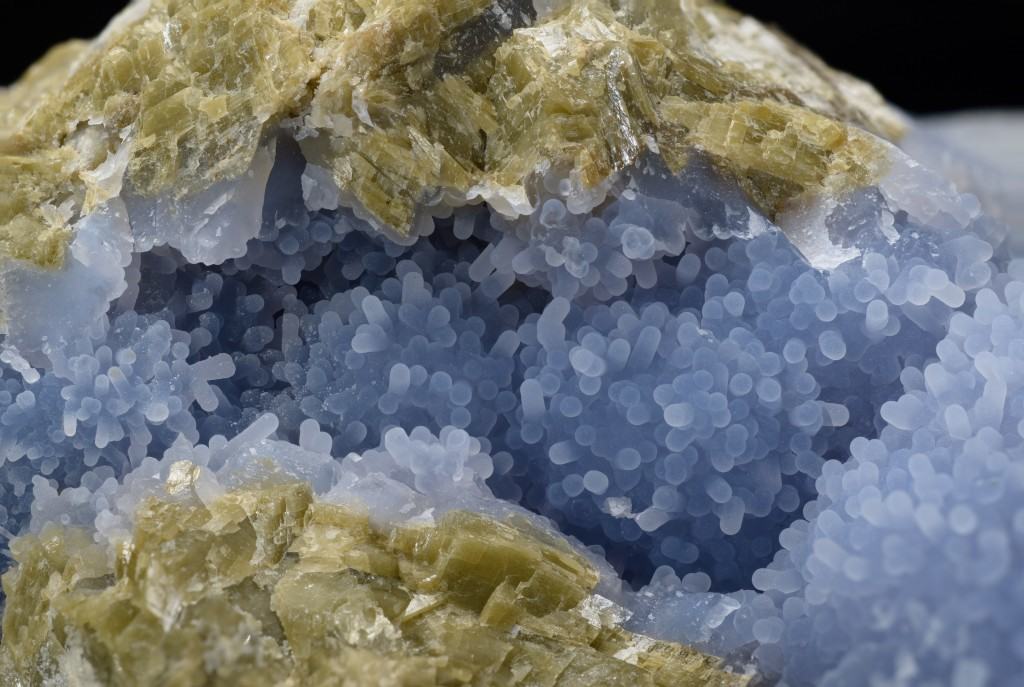
Chalcedony, the third stone of the circle, is essentially pure silicic acid. Typical for chalcedony is its structure. It is an extremely fine structure consisting of fiber-like crystals with in between some disseminated opal-silica. The total aspect of this often bluish gemstone is of an embracing gesture. This, in fact, is the essence of chalcedony: it represents the embracing power of the soul, an embracing power which is unselfish (silic acid), which is filled with soul power (opal is the gemstone of the soul) and which is not exclusive on the will side (chalcedony is not totally opaque like jasper).
- Dr. Simon van der Heide
Beryl,
facing lapis lazuli in the ring, is really in many ways is opposite. It
is a very hard (harder than quartz), totally transparent, hexagonal
columnar crystal with often a greenish hue which however disappears when
the crystal is heated. Chemically it is a beryllium aluminium silicate.
Beryllium is one of the most resistant elements. It plays a major role
in nuclear power plants.
Beryl’s
hardness and transparency, its upright columnar form (in North America
crystals of more than eight meters have been found), its sunlike
hexagonal symmetry, give a beautiful image of high intelligence. In the
story of the Holy Grail (the ancestor of the Grail family is called
Beryllus) we are told that devil cannot stay for even a moment if this
stone is present: there is nothing adversary forces fear more than being
seen through. The very diverse qualities of lapis lazuli and beryl are highly in need of
each other in human life. Devotion in the will forces should be guided
by clear, high intelligence. On the other hand, intelligence badly needs
devotion. And what is between the two extremes? It is the right way,
that way which is called righteousness in the Bible. In fact, it is the
way of inner development as described in Rudolf Steiner’s book
“Knowledge of the Higher Worlds”: starting with the path of devotion and
reverence and leading to the highest levels of knowledge.
- Dr. Simon van der Heide
Lapis Lazuli
takes the second place in the ring of gemstones. In the text of the
Apocalypse it is called sapphire, but there are some good reasons to
surmise that in the old days lapis lazuli was called sapphire whereas
the gemstone to which now the name of sapphire is applied, was still
relatively unknown in the Mediterranean area of that time.
The first
reason in fact is that Roman and Greek authors of the first centuries
A.D. describe sapphire as heavenly blue with gold specks. That is an
exact characterization of lapis lazuli and has nothing to do with what
we now call sapphire. The second reason is that sapphire in the present
sense would be the only gemstone in the ring which is not a silicate
or a form of silicic acid. Finally, if we introduce normal sapphire in
the circle, it would present an exception to the general order in which
there is always a totally transparent gemstone facing an opaque or
hardly translucent one.
The
most conspicuous property of lapis lazuli indeed is the heavenly blue
color with the golden specks of very small pyrite crystals, often
compared with the blue sky and golden stars. It is the kind of blue
which expresses devotion, that form of reverence which goes deep into
the will forces. True and pure devotion should be rooted in firm ground
and should be borne by ego force. Both these aspects appear in lapis
lazuli. In its very complicated chemical composition normal salt plays a
part, and on the other hand we find in the golden pyrite an expression
of the ego force of iron which has conquered the sulfur process, a true
Michaelic impulse.
-Dr. Simon van der Heide

Chrysolite,
opposite to jasper, is the seventh gemstone of the apocalyptic circle.
Jewelers call it peridot. It has a high transparency and a beautiful
golden green color. According to a jeweler’s book on gems (Mab Wilson) “
there is no blue in the green, even in the darkest version of itself.
Place it in the shade and it still remains sun-touched”.
Chemically
it is an iron magnesium silicate. Where do we find the combination of
iron and magnesium playing a major role in nature? In chlorophyll, the
green substance of the leaves in which the sun produces oxygen out of
carbon dioxide.
Evidently, this gemstone has a close relation to sun, to light in general.
Magnesium
in fact is an element with an enormous light potential. We experience
the relation, as indicated by Rudolf Steiner, between chrysolite and the
sense of sight.
The
qualities of jasper and chrysolite are clearly complementary. Unbiased
sensorial obversation is in urgent need of ego-conscious unselfishness,
the result in between the two poles being the way to truth.
-Dr. Simon van der Heide